
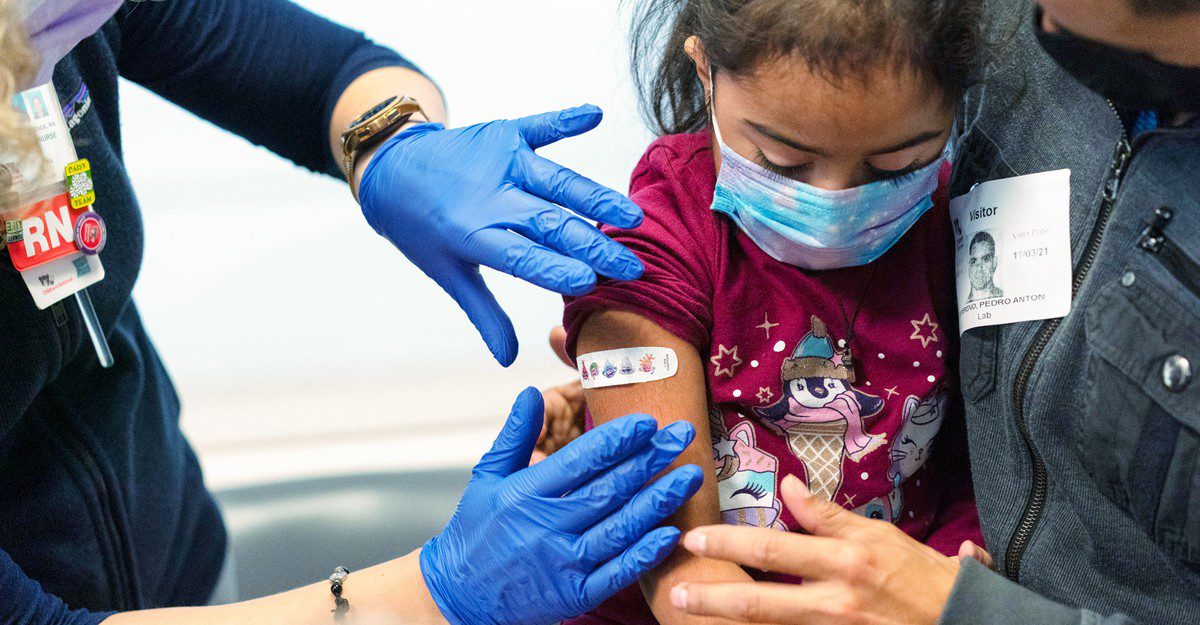
Karen Ocwieja delivered her twin sons last June, just weeks before Delta broke across the American Northeast. For months, she and her husband sheltered the boys, who’d been born premature, limiting their exposures to friends, family, and other kids, hoping to guard them from COVID’s worst. But all four of them still ended up catching the virus this January—the boys’ first bona fide illness. Then, in May, the twins tested positive again. Born with Ocwieja’s antibodies from pregnancy and now churning out their own, they likely will never know a world without COVID.
Still, Ocwieja, a virologist and pediatric infectious-disease specialist at Boston Children’s Hospital, hopes that the next time her kids encounter the bug, they’ll be far better prepared. The FDA is slated to finally authorize two vaccines for kids under 5 later this month, a milestone she has been waiting for ever since she got her first COVID shots, while carrying her sons. “It’s not going to be a free ticket to no more COVID,” she told me. But it will bring the twins one step closer to a life with fewer quarantines, more family gatherings, more playdates, more travel, and far more protection from the virus—all part of “the childhood we really want them to have.”


Ocwieja knows that her excitement puts her in a minority. An April poll conducted by the Kaiser Family Foundation found that less than a fifth of parents of kids under 5 are eager to vaccinate them right away; of the rest, about half say they definitely won’t sign their children up for shots, or will do so only if required. Plenty of parents still harbor worries over the shots’ safety, fretting that the injections might be more dangerous than the disease. And many who watched their kids contract the coronavirus, sometimes repeatedly, no longer feel much urgency about tacking on immunization—especially now that American society has opened back up, and nearly all mitigation measures have been dropped, signaling that the crisis has passed.
But the case for kids getting their shots as soon as possible is still strong, even two and a half years and billions of infections into SARS-CoV-2’s global sweep. Vaccination will not just protect children during the current surge but also prep them for the fall and winter, when schools resume session and another wave of cases is expected to rise. Since the pandemic began, at least 13 million American children have caught the coronavirus—a definite undercount, given the catastrophic state of testing in the United States. Of them, more than 120,000 have been hospitalized, more than 8,000 have developed a poorly understood inflammatory condition known as MIS-C, and more than 1,500 have died, nearly a third of them younger than 5. And an untold number have developed the debilitating, chronic symptoms of long COVID. “We can’t always pick out the child” who goes on to get the sickest, says Dawn Sokol, a pediatric infectious-disease specialist at Ochsner Health, in New Orleans. Many of the kids who ultimately fall ill are “running around, happy-go-lucky, no risk factors at all.” Vaccination, perhaps especially for the youngest among us, is an investment in the future.
It’s true that SARS-CoV-2 hospitalizes and kills a smaller percentage of kids than adults. But that small percentage has ballooned into catastrophically large absolute numbers. Experts have also dismissed the notion of stacking childrens’ stats against adults’. The more apt comparison, rather, weighs the life unimmunized kids could be leading if they were vaccinated. The availability of immunizations has turned COVID-19, especially in its severest forms, into a vaccine-preventable disease; that alone, experts told me, makes the shots worth taking.
And America’s youngest kids have few other protective or therapeutic measures available to them. Children under 2 are too young to mask; some treatments, including oral antivirals such as Paxlovid, aren’t authorized for use in kids under 12. And as more older people have gotten vaccines and kids haven’t—first because of ineligibility, and now because of lackluster uptake—COVID’s toll has bent toward the younger sectors of the population. Little kids, in recent months, have made up a growing proportion of documented SARS-CoV-2 infections, hospitalizations, and deaths in the U.S., a trend that sharpened during the peak of January’s BA.1 tsunami. During that period, the virus hospitalized five times as many kids as it did when Delta was dominant last year; children of color were disproportionately affected. Kids this young, whose bodies are still so early in development, are especially vulnerable to croup-like illnesses when viruses invade their lungs; the coronavirus also seems to increase the risk of developing chronic conditions, such as diabetes, that permanently alter a child’s way of life. And at that age, any illness is crummy, for both children and their families, who can’t just isolate their offspring and leave meals outside the bedroom door.
COVID shots hack away at all of those risks. In every age group green-lit for the shots, vaccination has cratered rates of hospitalization and death, even amid the rise of antibody-dodging variants such as Omicron. The injections aren’t quite as powerful at blocking infection and transmission, but they can still blunt the virus’s impact in these respects. Moderna, which is administering its under-6 vaccine as a two-dose series, spaced four weeks apart, says that its shot is about 40 to 50 percent effective at cutting down on symptomatic cases of COVID; Pfizer’s trio of doses for kids under 5—the first two separated by three weeks, the third by two more months—has clocked a very tentative efficacy of 80 percent.
Those estimates aren’t as good as the ones adult trials produced at the end of 2020. Back then, though, the contents of the shots were a near-perfect match for the version of SARS-CoV-2 that was circulating at the time; the virus has birthed a menagerie of new variants and subvariants since then, making it tougher for just a duo of doses to raise as strong a shield. Efficacy estimates also don’t paint the full picture of the shots’ protective power. Vaccinated people are still less likely to catch the virus, and to pass it on; even if they end up infected, their illness tends to be gentler and resolve faster. And efficacy against severe disease in children is expected to be very, very high for both brands of shots, though neither clinical trial reported enough COVID hospitalizations to properly calculate those stats. Among adults, the shots even seem to reduce the chances that a person will develop long COVID, which may impact around 25 percent of children who contract SARS-CoV-2—and for an infant or toddler, can be especially devastating. “We want kids to live long, healthy lives,” says Nathan Chomilo, a pediatrician and health-equity advocate in Minnesota. “If they have infections now, it can have impacts for years and years. There’s so much we’re still learning about what changes happen to the body in the long term.”
With their whole life ahead of them, the youngest kids among us, in some ways, have the most to lose. So it’s no surprise that some parents remain concerned about just how safe mRNA vaccines are for their infants and toddlers, especially so close to the technology’s global debut. Needles are also tough for tiny kids to take; forgoing a whole other vaccine could save busy, overstretched parents a trip or two or three. Annabelle de St. Maurice, a pediatric infectious-disease specialist at UCLA Health, who herself has a six-month-old daughter, sympathizes with some parents’ reluctance. “People feel their child is healthy and not at risk of severe disease, and they think they just don’t need the vaccine,” she told me. But she plans to sign her kid up for her shots “as soon as possible.”
The mRNA vaccine technology has been in tightly monitored development for decades, and since its public debut in 2020, has proved exceptionally safe in adults, teens, and older kids. The same attributes that make the shots ultrasafe in those populations should hold extra true in the youngest children. The pediatric vaccine pipeline is designed to prioritize safety above almost all else; it’s part of why the data from both Moderna and Pfizer took some time to generate. To minimize the risks of side effects, Pfizer’s under-5 doses are just three micrograms of mRNA, a tenth of adult doses, and Moderna’s under-6 doses are 25 micrograms of mRNA, a quarter of the adult dose. Both companies have reported that the infants and toddlers in their trials tolerated the vaccines very well. And no kids in either company’s studies developed the rare condition of myocarditis, or heart inflammation, that’s been spotted among some older kids who have received the mRNA vaccines. (COVID, notably, can cause myocarditis too—more commonly, and usually more severely, than what’s been linked to the shots.)
Any medical intervention, including a vaccine, will come with risks that some parents may take comfort in avoiding. But “not getting a vaccination is not zero-risk, either,” Chomilo said. Forgoing a shot while SARS-CoV-2 is still ricocheting about means accepting a higher chance of sickness, which could be severe, lasting, or even lethal; it means accepting the higher chance that the virus could use a child as a conduit, and spread rapidly to someone else. Chomilo, for one, feels confident about the risk-benefit math. Earlier this year, he hurried to get his son vaccinated as soon as he aged into eligibility. “After he turned 5, we were in the very next day to get him his shot,” he told me. “It was something that we had no hesitation about.”
In many ways, the rollout of this last round of shots might feel ill-timed, with few rewards waiting on the other side. Fresh off Omicron’s winter and spring surges, many kids have recently been infected and may now be at least partially buffered from a viral encore. Add to that “the view that maybe the pandemic is over, and we don’t need these vaccines quite as much,” de St. Maurice told me, and plenty of parents are primed to wait and see what comes next before jumping to vaccinate their kids. Summer’s right around the corner, and families are eager to move forward, past COVID, into the sunny, post-pandemic season that last year seemed to promise but never delivered. Masks and other mitigation measures, too, have been phased out of schools and other public venues, vanishing some of the most visible markers of the coronavirus’s crisis-level threat. If normalcy is the watchword, it doesn’t square with an urgent call for little kids to sprint toward an inoculation line.
But there’s still an urgent argument to be made for near-term vaccination. Infections tend to leave behind rather scattershot protection, especially if their symptoms weren’t all that severe; the defenses laid down by the original Omicron subvariant, BA.1, also don’t seem to guard particularly well against some of its wilier siblings, including BA.2.12.1, which has become the dominant strain in the U.S. When vaccines are added on top of infection, though, protection skyrockets, both broadening and deepening, in order to help the body better recognize, then thwart, a whole bevy of SARS-CoV-2 morphs. “Anything you can do to help more, why not do it?” Ocwieja, the Boston pediatric infectious-disease specialist, told me. Her two sons, who have each caught the coronavirus twice, clearly weren’t protected enough from their first viral encounter to stave off a second, just a few months later. Trials in older kids also haven’t raised any safety concerns about inoculating children who have survived the virus.
COVID, after all, will be a recurring danger for most of us, especially as the virus continues to spread with abandon, and new subvariants keep branching off. The wave of cases currently gripping the U.S. could yet get worse; a spike of even greater magnitude or speed could follow. Sokol, the New Orleans pediatric infectious-disease specialist, also points out that summer’s no time to let down our guard. In the South, especially, warm weather can pose its own perils, as people flock indoors unmasked to beat the heat. Families are also gearing up for travel, which will bring them into contact with new people, and potentially offer the virus new networks in which to spread. Vaccinating kids now, de St. Maurice told me, will steel them against what is inevitably on the horizon. Waiting for things to get worse is “too late,” she said. “You can’t predict when the next surge is, and the body needs time to mount an immune response.” Pfizer’s three-dose series, for instance, takes three months to complete—just in time for the start of the fall school year, if parents start now. “And there’s no guarantee the next variant will be as kind to kids,” Chomilo said.
Every immunized body simply becomes more inhospitable to the virus, and gives it one less place to safely land. Vaccinated kids will pose less risk to vulnerable members of their communities, including immunocompromised or older people and infants under 6 months, and will help loosen the virus’s grip on the country. The virus’s impacts on kids, after all, haven’t just been direct: Countless children have, for two and a half years, had to endure a steady drumbeat of school closures, exposures, and the heartache of sick caregivers and friends—many of whom have died.
But the push to vaccinate America’s youngest kids will still be an uphill fight—especially in parts of the country where the discourse about shots remains fraught. In Louisiana, where Sokol practices, just 39 percent of kids 12 to 17 years old, and 12 percent of kids 5 to 11 years old, have opted for their first two Pfizer shots. Many of the people in her community have been swayed by misinformation about the vaccines—that they’ll negatively affect kids’ fertility, or that they contain microchips, or that they’re still experimental and not to be trusted. “I don’t think it’s going to be an easy battle,” she told me. She and other experts pointed out that there isn’t just one thing staying parents’ hands over the COVID vaccines; the sluggish uptake is a multifaceted problem that will demand solutions just as diverse as strategies to vaccinate adults, if not more so. Hopefully, Sokol said, further devastation—more loss, more death, more disease, colliding further with little kids’ lives—won’t be necessary to persuade parents to protect their youngest. As children grow into adults, their vulnerabilities will increase; delays in protecting them could also ramp up the risks of exposures, whose effects may be impossible to erase. But Sokol and others have little choice but to play the long game. “Maybe a year from now,” she told me, “we’ll have made some steps forward.”
Source by www.theatlantic.com
