
The last time I tried to wait out the pandemic, I drove south. My dog and I traveled nine hours from San Francisco to the Anza-Borrego Desert, which sprawls over more than half a million acres near the Mexican border. Most of that territory is untouched wilderness, rocky washes home to deer, pumas, and golden eagles.
The place felt solitary. That’s why I chose it. I work as a doctor in an emergency room, a hospital, and an HIV clinic. I also take powerful immunosuppressants for autoimmune disease, one of which rendered the coronavirus vaccines far less effective in my body. My co-workers had tried to see all of the COVID patients to protect me, but as Omicron exploded in January, that became impossible. The woman who’d broken her ankle tested positive. The grandfather who’d lacerated his scalp did too, just like the middle-aged man who wanted to detox. Treatments for COVID were in short supply, and I wanted to get through the surge alive. So for several weeks, I canceled work, a privilege most can’t afford. Forced into isolation, I decided to spend a week where solitude felt deliberate.


Back then I would have described my trip to the desert, and pandemic life broadly, as an intermission. The moment caseloads tumbled and hospitals stocked treatments, I would go hiking in Japan. I would brave the dating scene after a two-year hiatus. I would deploy with Doctors Without Borders. Meanwhile, I reassured myself that I just had to hold out a few months longer, even though the deadline kept retreating. Mine was an outlook equally comforting and wrong.
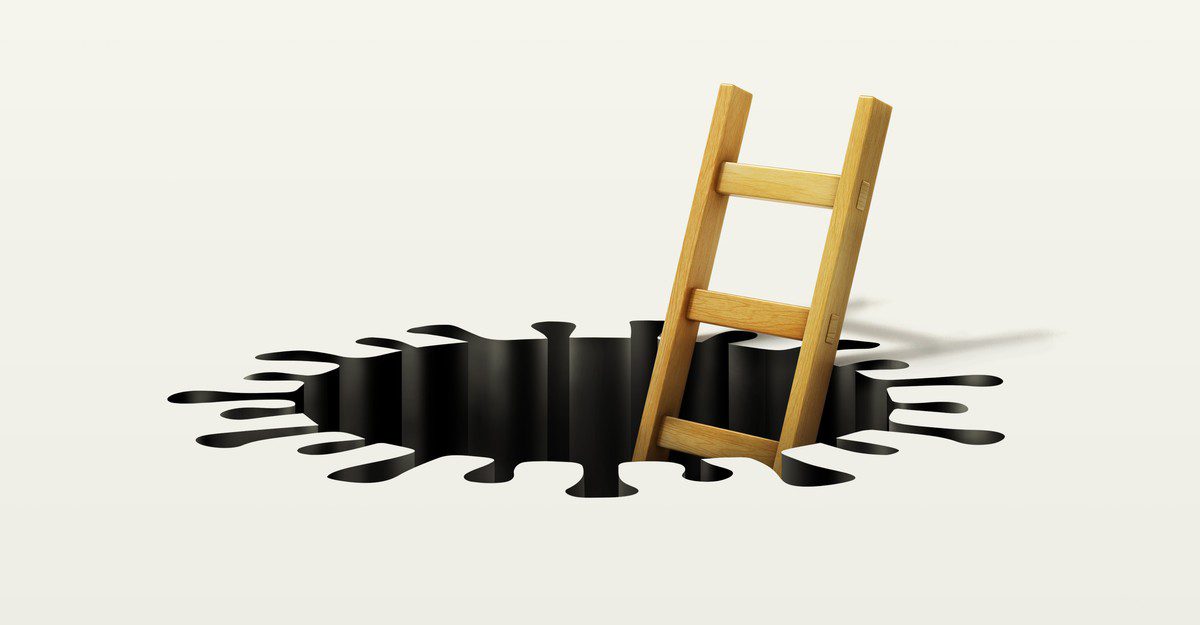
Kurt Vonnegut famously taught about six archetypes that underpin stories. In a video of one of his lectures, he draws on a chalkboard an x-axis for time and a y-axis for degree of good fortune, then traces a sine wave that plummets before rising again. “We call this story ‘Man in Hole,’ but it needn’t be about a man, and it needn’t be about somebody getting into a hole,” Vonnegut says. It’s a tale—of fall and salvation, of mettle forged through trials, of ultimate catharsis and victory—that humans tell naturally. And it needn’t be about a man and a hole. It could be about a world and a virus.
People in the U.S. have heard this story repeatedly over the past two and a half years, the media and government casting the downturn of each surge or advent of each therapeutic as the ladder that would soon carry us from the hole of the pandemic. Until that deliverance, we could cultivate rooftop gardens and sourdough starters to stave off our impatience. It’s less scary to rewrite reality into a reassuring plot arc—one with a familiar contour and clean resolution—than to envision a story that doesn’t end, or one whose ending permanently reconfigures our world.
But nearly eight months after my return from Anza-Borrego, the bridge of my nose is raw from my N95 mask. Yet another Omicron subvariant is spreading, as one strain supersedes another. Despite stunning progress in vaccines and drugs, COVID still threatens to hospitalize or disable me, and I don’t foresee that reality changing imminently. While the mirage of normalcy recedes, glittering and unattainable, I remain marooned in another desert, staring down the truth that a sense of closure won’t arrive anytime soon.
SARS-CoV-2 is only the latest pathogen to upend people’s lives. Working as a doctor who specializes in HIV—a virus that profoundly affects my patients yet is ignored by most Americans—has taught me some truths about pandemics. The first time someone asked me whether HIV was “still a problem,” at a Christmas party years ago, I almost choked on my drink. But the question made twisted sense in a country where the notion that a pandemic is over depends little on science and more on which communities are affected.
The people I treat who gasp from pneumonia or seize from meningitis because they can’t access or adhere to HIV medications are invariably poor, and many are Black or Latino. My acquaintance at the party was a straight, white, wealthy man in his 60s. He could exist in a story where the man had climbed out of the hole. Tale concluded, the credits rolled. That conversation is the reason why, whenever someone says the coronavirus pandemic is over, my first question is always, “Over for whom?”
Though I‘ve endured a sliver of the adversity my patients have, I’m learning what it’s like to embody a less comfortable story than the one others are telling. I walk by packed bars. I scroll through photos of maskless crowds at concerts. I hear people use the phrase “during the pandemic,” as if it’s ended. After multiple false starts, the man in the dominant version of the story escaped the hole after the Omicron surge once and for all.
That narrative has real consequences, including lax precautions, risky workplace policies, and woefully inadequate funds for global COVID efforts. It sidelines millions of Americans: not only people like me dealing with high-risk medical conditions, but also survivors confronting long COVID, frontline workers depleted by burnout, and loved ones grieving those who have died, disproportionately people of color. I don’t want my fellow San Franciscans to stop eating out or traveling; their lives will be freer than mine, a situation I accept as unavoidable even if it saddens me. I do wish, though, that the government would value my life by investing in preventing COVID transmission rather than issuing ever more anemic guidelines. And amid such policy failures, I wish people with less to fear from the virus would shift the burden off the shoulders of the more vulnerable, by wearing masks on public transit, staying home when they’re sick until a rapid test turns negative, and keeping up to date on boosters.
After far too long, I have stopped clutching the myth of Man in Hole, in which I must either pretend the pandemic is over—a self-deception that could land me in the hospital—or else wait indefinitely for a ladder, watching clouds scud over desert lowlands as I forfeit plans and dreams. I need a story to replace it, and for that, I’ve turned to my patients.
A few years ago, I treated a young man who had contracted HIV just out of college. A pandemic that had never touched him suddenly shaded his life, and for months, that paralyzed him. He didn’t look for work; he played video games all day and nearly lost his housing. Then, six months after his diagnosis, he started bringing a notebook to our visits. In it, he fashioned a plan. Nothing sweeping: Stop by two restaurants to ask about jobs. Get glasses. Post a dating profile. A year into our time together, he was working in a café, had an adoring boyfriend who knew his status, had undergone a long-overdue surgery, and had started graduate school.
I started carrying a notebook recently. The plans I scribble down differ from those I might have conceived before the pandemic but share one feature: They are possible despite my constraints. I rode my bike from Seattle to Vancouver for an outdoor vacation. I attended a wedding in an N95 mask. I made enchiladas with friends after we all took rapid tests. I spoke on the radio about the injustices of pandemic policy, because adapting to my new reality doesn’t mean abdicating the battle for a better one. That, too, I learned from people with HIV, who formed committees to pressure the FDA and the NIH, demanded inclusion in policy decisions, and were jailed for protesting for effective antiretrovirals, including one used in COVID treatment.
I still seethe whenever I show up to an event that’s too overcrowded and underventilated for me to stay, or board a plane where the overturned mask rule reminds me of the nation’s disregard for my health. But action is nonetheless a relief after spending so long stymied. If I were to chart my life on Vonnegut’s chalkboard now, I’d draw a steep plunge followed by a slow and bumpy incline that hasn’t yet neared the original precipice. It’s a tale less tantalizing than Man in Hole, and galling in its incrementalism, but it does have one advantage: It’s true.
Some people visit Anza-Borrego only after the rains, in perfect conditions, when a riot of wildflowers suffuses the land with color. I never have. People tend to assume that this is when the desert is most alive, but in truth, even in the most arid conditions, bobcats prowl, coyotes slink, and foxes rear their kits. When the wild sheep can’t find water, they ram barrel cacti and devour the wet pulp. These animals know well that the rains don’t always come. During the dry spells, life carries on.
Source by www.theatlantic.com
