
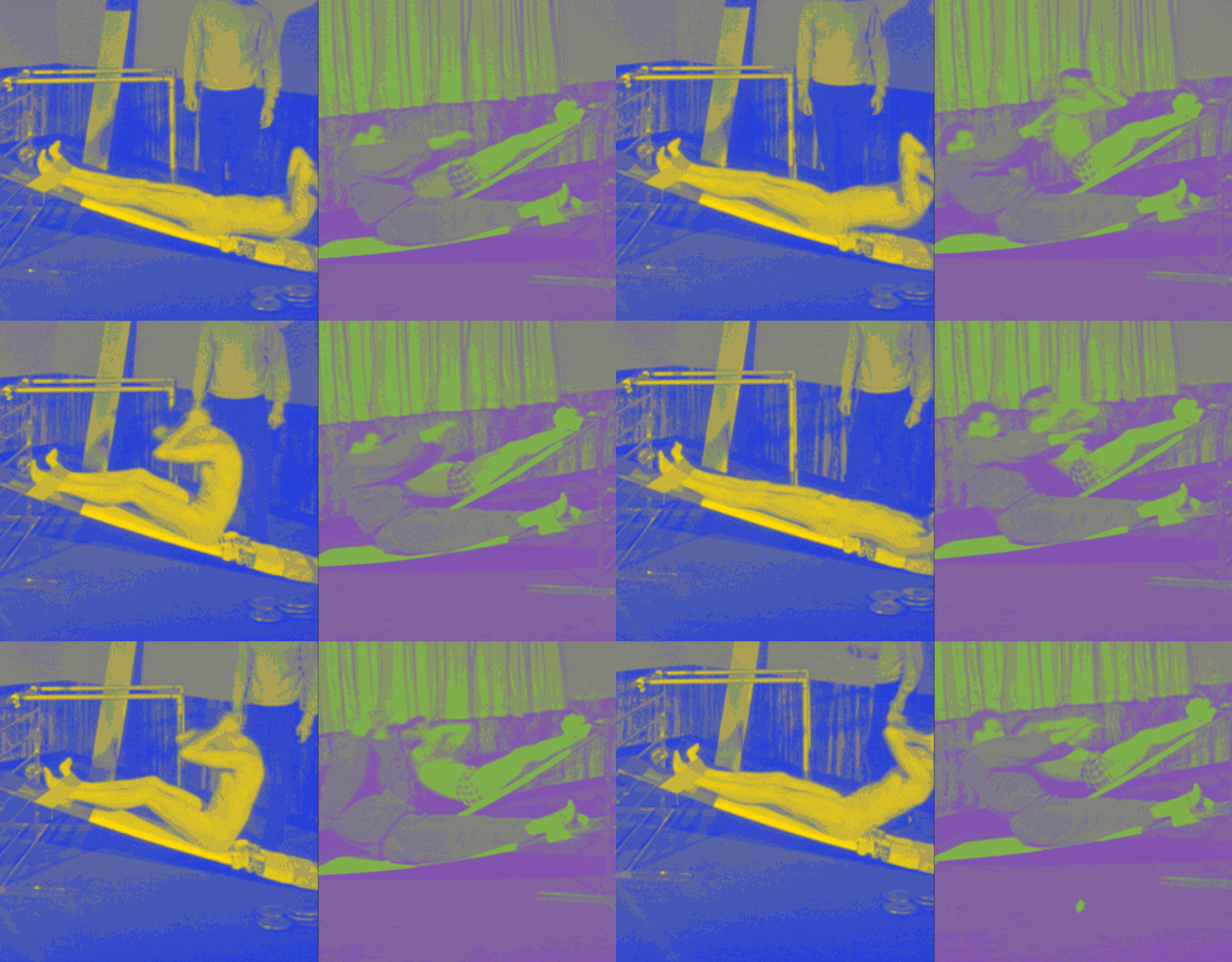
When I think of a sit-up, my mind flashes immediately to the (carpeted, for some reason) floor of my elementary-school gym. Twice a week, our teachers marched us there for ritual humiliation and light calisthenics, and under the watchful gaze of a former football coach with a whistle perpetually dangling from his lips, we’d warm up with the moves we’d been told were the building blocks of physical fitness—jumping jacks, push-ups, toe touches, and, of course, sit-ups.
With rare exception, we were bad at sit-ups. We’d try our best, taking turns leaning on our partners’ toes as they threw their torsos up and forward for a count of 10. But kids are floppy creatures, and sit-ups are an especially floppy exercise. In gym class, our lower backs hunched, our necks strained, and our arms flew away from their cross-chest Dracula pose. Once a year, beginning in elementary school, the Presidential Fitness Test required us to do as many sit-ups in a minute as our little bodies could stand. Eventually we were introduced to crunches, a truncated variation of the sit-up that made our by-then-adolescent flailing a bit less dramatic.


The idea behind those lessons had been the same for generations: Doing sit-ups or crunches at a high volume is not just a reliable way to build physical strength, but a reliable way to measure it. As both a unit of exercise and a way of life, the sit-up was endorsed by the only kinds of fitness experts most people had access to at the time—gym teachers, my exercise-nut dad, the hardbodies in 1990s fitness informercials hawking questionably efficacious gadgets such as the Ab Roller. To question its utility would have felt only slightly less bizarre than questioning whether humans benefit from going for a little jog. But by the time I aged out of gym class, in the mid-2000s, the sit-up had already begun its quiet disappearance from American fitness. In the years that followed, this iconic exercise would yield its status further. Old-school exercisers may be surprised to hear that this fall from grace is now complete. The sit-up is over.
The institutional push to get Americans to exercise started in the 19th century, when federal authorities feared that new kinds of work and mass urban migration were turning a nation of hearty farmworkers into one of sedentary city folk. The situation was regarded as nothing less than a national-security risk—a physically weak nation supplied its military with weak soldiers. These anxieties have long influenced American ideas about fitness, and cemented the link between military exercise practices and civilian exercise trends. So it was that the sit-up, which has been around in one form or another since antiquity, did not fully conquer America until the early 1940s, when the United States Army enshrined it in cadets’ physical training and testing. That decision all but guaranteed that children would be flopping around on the floor at school for the better part of a century afterward. In later years, the U.S. Navy and Marines endorsed the crunch. Whichever variation was in play, military personnel had to complete as many as possible in two minutes—double the time that would later be assigned to grade-schoolers, but otherwise the same test.
Our understanding of how the body moves and gains strength has evolved, to put it mildly, in the past 80 years or so. When researchers of old sought to understand the body, they considered its elements separately. “Anatomists would remove the connective tissue around the muscles,” Pete McCall, a personal trainer and fitness educator who has trained instructors for the National Academy of Sports Medicine and the American Council on Exercise, told me. Then they would observe and manipulate the muscles lying flat. That, McCall said, is how they decided that your abdominals pull your spine around, and that your abdominals need to pull your spine around a lot in order to get and stay strong.
Now we know that muscles don’t function alone. Abs are the most visible muscles in a ripped midsection, but they work in concert with a slew of others, including the diaphragm, obliques, erector spinae, and the muscles of the pelvic floor, in order to make all of the tiny movements that most people really only notice after they’ve slept funny. When people talk about the “core,” which has largely replaced “abs” in fitness jargon, they mean all of these muscles, as they work together. But it took decades of research to realize the error, and in the meantime, the decentralized approach to human anatomy became highly influential among another group that has helped to set the conventional wisdom about exercise: Americans trying to get swole. “The first people who popularized all of this exercise were bodybuilders trying to sculpt and define one muscle at a time,” McCall told me. Spot training—the idea that you can effectively remove fat and increase muscle mass in a single area of the body through targeted exercise—is a myth that has been stubbornly resistant to change among novice exercisers, and especially when it comes to abs. The spammy false promise of one weird trick to reduce belly fat lives on in the dregs of internet advertising to this day, precisely because people click on it.
As researchers studied more subjects who were upright and, importantly, alive, their understanding of human strength began to change. “If you really want to understand anatomy and how muscles function, you need to understand what they do while the human body is on two feet moving through gravity,” McCall said. When I asked if he could pinpoint the beginning of the end of the sit-up, he directed me to the work of Stuart McGill, a Canadian biomechanics researcher and arguably, he said, the person most responsible for the sit-up’s demise.
McGill, a professor emeritus at the University of Waterloo, in Ontario, and the author of the book Back Mechanic, didn’t begin his academic career with a particular interest in the sit-up; his work focused on the spine. But throughout the 1990s and 2000s, he led research that changed the way fitness experts thought about exercise. His findings showed that sit-ups and crunches weren’t just mediocre strength-building moves; they were actually hurting lots of people. “If you bend the spine forward over and over again when not under load, not much happens to the spine,” McGill told me. He gave the example of belly dancers, whose movements he has studied: They flex their spines repetitively without high incidence of injury. “The problem occurs when you flex over and over again with load from higher muscle activation or external objects held in the hands.”
If you’ve ever been told to lift with your legs, this is why. When a person’s spine curves and strains in order to move weight through space—like when a bunch of third graders flail through a set of sit-ups—the movement stresses their spinal disks. The more often you ask your spine to flex in those circumstances, the riskier it is. This is how people who spend their working lives moving inventory around a warehouse or stacking bushels of produce onto trucks end up with back pain later in life, even if they can’t point to any acute back injuries suffered along the way. McGill found that the most reliable way to avoid this kind of chronic problem is to brace your core when you pick up something heavy. That means tensing key muscles in order to protect your spine’s structural integrity, and to help shift the effort to your hips and legs. Not coincidentally, weight lifters follow this advice when they safely execute a dead lift. Perfect form is not always possible for workers dealing with irregular loads and crowded spaces, but intentional exercise is all about form. Getting it right and activating the intended muscles is the whole point.
The sit-up and crunch violate all of these principles. The exercise asks you to pick up something heavy, but because you’re lying on the ground and the heavy thing is your upper body, there’s no way for you to brace your core and shift the effort to the big, high-capacity muscles of your legs. And the exercise is, by its nature, repetitive. For generations, schoolchildren and troops were both told to do as many sit-ups or crunches as possible in order to score well on compulsory testing. Some people can do these exercises with no problem, McGill stipulated, but that capability depends largely on genetic factors such as how light- or heavy-framed a person is, not on any particular executional skill. For population-level instruction and testing, the sit-up simply does not work.
As McGill and other experts published their findings, he began to hear from people who had found injury patterns that matched his research—most notably, from trainers and physical therapists in the U.S. and Canadian military, who were questioning the sit-up’s primacy in their fitness instruction. In the past decade, every branch of the U.S. military has begun to phase out sit-ups and crunches from their required testing and training regimens, or else they have made them optional, alongside more orthopedically sound maneuvers such as the plank. Spokespeople for the Army and the Marines confirmed to me that these decisions in their branches were made in part to avoid the high rates of lower-back injury found among troops training for speed sit-up and crunch tests.
According to McCall, the fitness educator, when the military decides that a long-standard exercise is no longer up to snuff, lots of trainers take notice. Because of the scale and prestige of the military’s training programs, their institutional practices remain highly influential on civilian exercise, which has helped to hustle the sit-up further to the margins over the past few years. Childhood fitness testing has relented, too. The Presidential Youth Fitness Program, which replaced the Presidential Fitness Test almost a decade ago, now recommends that children practice curl-ups, which are a much more subtle movement developed by McGill that asks exercisers to brace their core while lifting their head and shoulders only slightly. (If your fitness routine regularly includes planks, bird dogs, or dead bugs, that’s also McGill’s doing—he didn’t develop those exercises, but he did usher them into mainstream use as sit-up alternatives.)
If you hadn’t yet noticed crunches disappearing around you—or if you have a trainer who still puts you through your sit-up paces—McCall said he wouldn’t exactly be shocked. Like many other American industries, the fitness business is consolidating, but it still contains tons of independent instructors and small businesses. Sit-ups and crunches have been discouraged by educators within the industry for years, but there are no licensing or continuing-education requirements for teaching exercise, and if trainers don’t seek out new information and techniques, it can take a while for good information and new ideas to get through to them. Even up-to-date instructors may have plenty of clients who just won’t let go of exercise as they’ve always understood it. “A good trainer will educate the client,” McCall told me. “But the sad fact is, with some clients, if you didn’t have them do two or three sets of crunches, they would feel like they’re not getting a good workout.”
Source by www.theatlantic.com
