
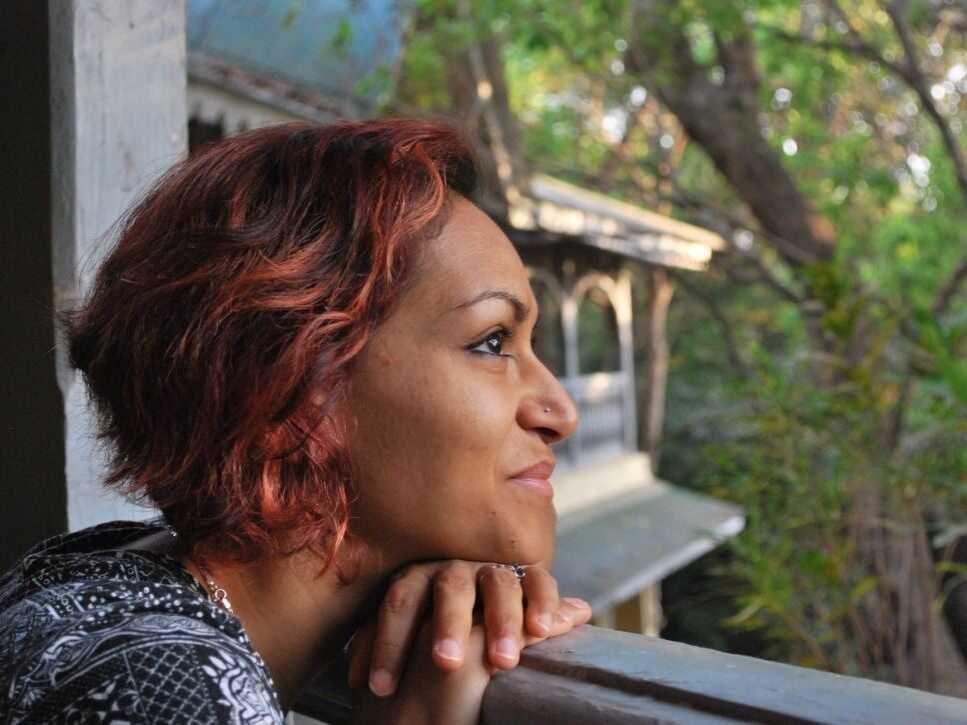
Dr. Devika Bushan went public about her bipolar disorder while serving as California’s Acting Surgeon General. She writes: “I have never been more convinced that to dispel mental health stigma, professionals who feel comfortable need to speak our truths — to spread the understanding that mental health conditions, especially serious ones, are treatable.”
Ashish Kundra


hide caption
toggle caption
Ashish Kundra

Dr. Devika Bushan went public about her bipolar disorder while serving as California’s Acting Surgeon General. She writes: “I have never been more convinced that to dispel mental health stigma, professionals who feel comfortable need to speak our truths — to spread the understanding that mental health conditions, especially serious ones, are treatable.”
Ashish Kundra
A few brave professionals have publicly shared their journeys with bipolar disorder — including psychologist Kay Redfield Jamison, physician Justin Bullock and entrepreneur Andy Dunn. Recently, while serving as California’s Acting Surgeon General, I chose to join their ranks.
To help dispel stigma and to spread hope, I shared my own long path to diagnosis and recovery in a National Alliance on Mental Illness conference keynote speech, social media messages and a personal essay in the LA Times.
Despite my early fears that having bipolar disorder would forever derail my path, I shared that I now attribute much of my professional and personal success to the lessons I took from my mental health journey.
This disclosure reached millions, and has brought me the gift of dialogue and deep kinship with hundreds of people touched by mental illness who’ve reached out to me — many of whose voices sound like mine from years past.
Many wrote that they have never seen someone in a high-profile public role with a serious mental illness speak out. Some, in the midst of the hardest parts of their own journeys, wrote that my words were “live-saving” and had helped them feel less alone, ashamed and hopeless.
I’ve been in tears at the vulnerability people have shown me and their raw, all too recognizable truths.
For instance, one parent described their teenage daughter’s struggles with bipolar disorder:
“It has been a difficult journey for us and her,” they wrote. “Thank you… for making us feel a little less alone and giving us hope that [our daughter] has a beautiful life ahead!”
My most fervent hope — and the reason I chose to “come out” — had been precisely to reach those still finding their paths to recovery. To help them know that there is a way forward. That a difficult diagnosis or a long period of struggle does not preclude living out their dreams — to hold out hope that with the right treatments, a full life is possible.
The stakes couldn’t be higher. More than one in five American adults lives with a mental health condition — and about one in twenty has a serious mental illness like bipolar disorder — with rates soaring during the pandemic. And it can take years to receive the right diagnosis and find the right treatments that return us to our full functioning and potential. While suffering, we’re at increased risk for dying 10 to 20 years earlier, including by suicide or from chronic conditions like heart disease.
Stigma and its cousin, internalized shame, end up compounding the many difficulties on the road to recovery, leaving us to believe that we are undeserving of help and alone in our struggles — and leading to discrimination in the workplace and in opportunities and access to care. Many find the experiences of stigma and discrimination to be more painful than mental illness itself. In fact, in part because of stigma, more than half of adults with mental illness are not in treatment.
Sharing our stories allows us to chip away at this stigma and spread an understanding of the commonalities in our experiences — that with treatment, positive outcomes are not only possible, but likely.

But the messages I’ve received have underscored just how much further we have to go in achieving equal access and acceptance for mental health treatment as for physical health.
One business professional of Indian origin wrote of the stigma bordering on taboo that limits access to treatment in our culture.
“Growing up in India, speaking about mental health was traumatic, and I’ve seen family members in significant pain who were never able to ask for or seek help,” she wrote [emphasis added]. “My mother, now deceased, would have [benefited] had she known she could have asked for help, been treated, and lived a fulfilling life.”
Like former me, countless others today are not free to live as their full selves free from discrimination and unfounded judgment blemishing their careers.
“I’ve been told by bosses and others that I don’t have potential because of what I struggle with, and I’ve ended up internalizing it,” wrote one woman.
I also heard from scores of health professionals, who are particularly prone to hide their diagnoses and not seek treatment for them.
Stigma is embedded directly in regulatory processes in medicine like those of state licensing boards, which can take punitive, paternalistic approaches to monitoring clinicians with mental health conditions, even when well-controlled.
A mental health professional wrote about needing to hide their bipolar diagnosis during their training. “I daily hear people look down and shame those who have this disorder in [the] field, even coworkers, people who I learn from in my clinical training,” they wrote. “I hope that one day I can fully convince myself that my success as a clinician will not be reduced to this disorder
A medical student living with bipolar disorder wrote: “I have felt silenced and often times like I don’t belong in this field. You have reminded me that I do belong here and that my diagnosis will not prevent me from being successful as a doctor.”
In the wake of these outpourings, I have never been more convinced that to dispel mental health stigma, professionals who feel comfortable need to speak our truths — to spread the understanding that mental health conditions, especially serious ones, are treatable. This is essential to help change the prevailing stereotypes and often pejorative cultural associations tied to mental illness, and to enhance access to care.
Public opinion of mental health conditions is still largely anchored in extreme images of people at their most unwell. When we make space to understand varied individual mental health journeys, including recovery, we embrace nuance and context.
When we join our disparate voices together and share our stories — of illness and wellness — we can and will dispel stigma, shame, and stereotypes, and achieve lasting change in the limiting and incomplete ways many currently view those of us with mental illness.
In my own life, I’ve come to see my mental health journey as driving my superpowers — as a doctor, leader, and loved one. As my son’s namesake, Rumi, once wrote: “The wound is the place where the light enters you.”
My journey has brought me deep self-insight and shown me my own capacity for strength and vulnerability. It’s given me strong motivation to implement the boundaries and care strategies it takes to stay well, as well as an empathic ability to support others through their most vulnerable moments.
Many readers wrote that hearing my perspectives empowered them, some for the first time, to reinterpret their mental health experiences as enabling their most unique assets.
“As someone living with [complex post-traumatic stress disorder], I… never before thought it could be my superpower,” wrote one reader.
“Now, after almost a decade, [I] can see clearly as you do that bipolar did not fundamentally change me or realign my understanding of self, but it has been one of the greatest gifts I have ever been given,” wrote another.
Out of everything, I’m most grateful that my disclosure has given me the chance to forge deep bonds across a global community and to join a movement — with a shared conviction to reclaim our narratives.
Working together, I have real hope that we will end mental health stigma and discrimination, and usher in better access to treatment within our lifetimes. So that our children can live in a world that honors and enables their fullest potential.
Dr. Devika Bhushan is an equity-focused pediatrician and public health professional who has served as California’s Acting Surgeon General. She’s an Indian-American immigrant and a parent. She’s on Twitter and Instagram as @DrDevikaB.
Source by www.npr.org
