
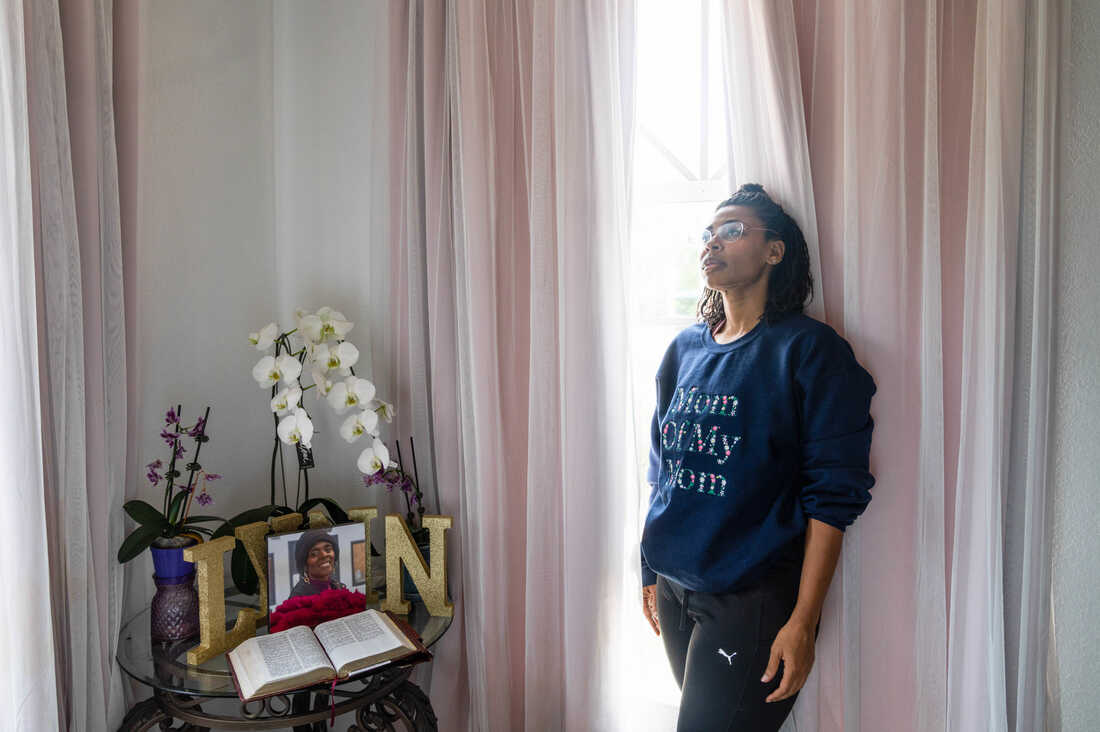
Jacquelyn Revere, 35, moved back home at 29 to care for her mother, who had developed Alzheimer’s disease. She spent six years as her caregiver and shared her experiences on TikTok, building a large following on her channel, “Mom of My Mom.”
Lauren Justice for NPR


hide caption
toggle caption
Lauren Justice for NPR
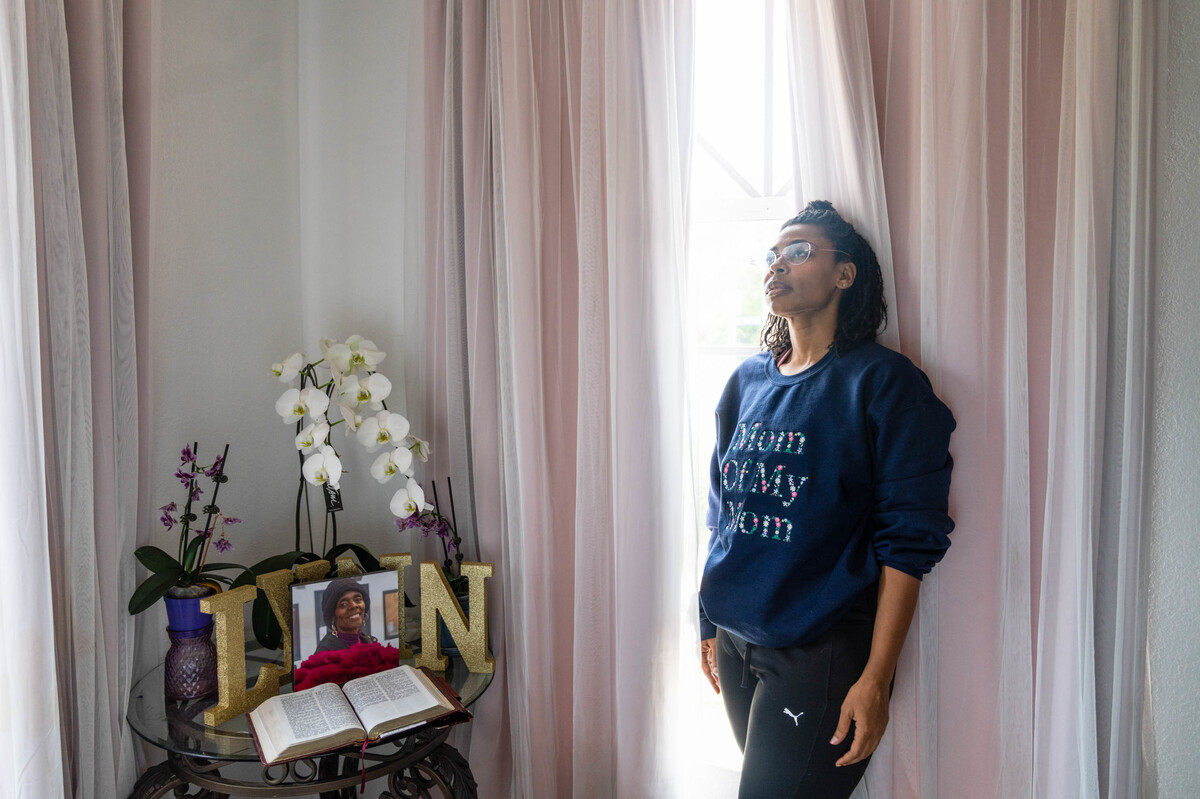
Jacquelyn Revere, 35, moved back home at 29 to care for her mother, who had developed Alzheimer’s disease. She spent six years as her caregiver and shared her experiences on TikTok, building a large following on her channel, “Mom of My Mom.”
Lauren Justice for NPR
It all changed on a Saturday night in New York City in 2016. Jacquleyn Revere was 29 years old, and headed out for the evening to attend a friend’s comedy show.
She was still on the subway when her phone rang. It was a friend of her mom’s, back in Los Angeles. That’s weird, Revere thought. She never calls.
“And while I was on the subway, my mom’s friend said, ‘Something is wrong with your mom,'” Revere said. ” ‘We don’t know what’s going on, but your mom got lost driving home. What should have been a 15 minute drive, ended up taking two hours.’ “
Revere flew back to L.A. At her mom’s home in Inglewood, she found foreclosure notices, untreated termite damage on the porch, and expired food in the kitchen.

Her mother, Lynn Hindmon, was a devout Evangelical who worked for her local church. A slim, regal, self-declared “health nut,” Hindmon was now forgetting to pay bills and couldn’t remember who she was talking to on the phone. This was just a few years after Hindmon herself had moved in with her own mother, Joyce Hindmon, Revere’s grandmother, after the matriarch had been diagnosed with Alzheimer’s.
“My mom was taking care of her mom, who had Alzheimer’s, [and] not telling anybody how hard it was or that she needed help, or that it was completely stressing her out,” Revere says.
“And then it became about me coming home to be in a house with three generations of trauma, and working my way through that … while also being afraid and young and scared and not knowing what to do.”
It would take nearly a year before they got the diagnosis that confirmed what Revere already suspected: Her mother had Alzheimer’s, too. Barely 10 years since Revere left home, she found herself moving back in with her mom and her grandmother — this time as their full-time caregiver.
“That first year and a half, I was just filled with fear: What if I lose the house?” Revere says. Because of the stress, she says, “I went through bouts of migraines. My hair, right in the middle, fell out completely.”
“I had to figure out how to get control of all the banking, figure out the passwords, make sure the bills are paid, make sure everything’s taken care of.”
In 2017, her grandmother died. Revere’s grief and isolation felt overpowering. Her friends in their 20s either couldn’t relate, or thought she was “wallowing in pity,” Revere says.
Trying to get them to understand what her daily life was like now seemed impossible. “I just wanted to find people I didn’t have to explain everything to,” she says.

In one viral TikTok video, Lynn Hindmon, Revere’s mother, looked at old photographs of the two of them hanging on the wall and called her “Mommy.”
Lauren Justice for NPR
hide caption
toggle caption
Lauren Justice for NPR
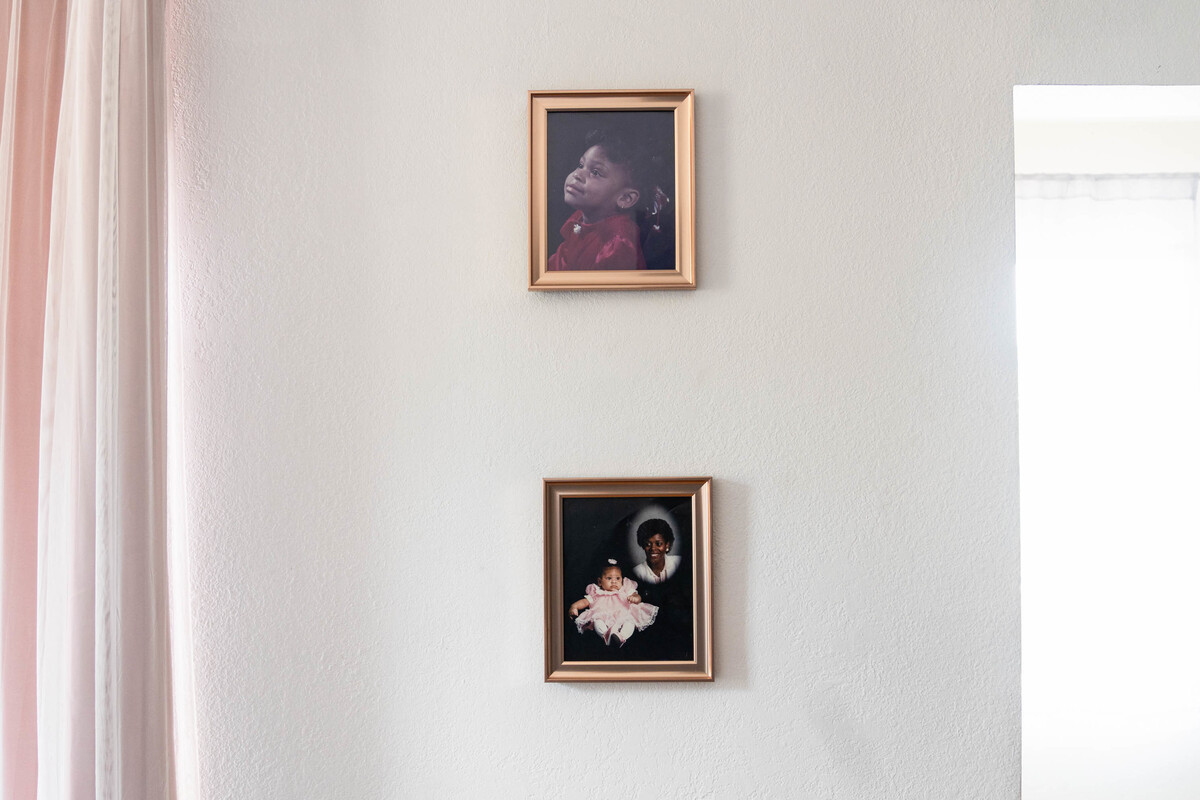
In one viral TikTok video, Lynn Hindmon, Revere’s mother, looked at old photographs of the two of them hanging on the wall and called her “Mommy.”
Lauren Justice for NPR
Revere even tried a support group for caregivers, an hour’s drive away. But the other attendees were decades older, and had more financial resources. “[They] would say ‘And now I have to take equity out of our house,’ or ‘I’m thinking of reaching into our 401k.’ And then I would tell my story, and people would be looking at me like … a charity case, or like my problem is unsolvable. … If anything, I left and I just felt worse.”
But these days Revere no longer feels so alone. In fact, she’s a celebrity of sorts on TikTok, at least among the hundreds of thousands of people who post about dementia and the difficulties of caring for a loved one with the disease.
Over the past few years, Revere’s account, @MomofMyMom, has become wildly popular, with more than 650,000 followers. Many of her most ardent fans have told her that they feel like they personally know her and her mom. Revere has both found a supportive community, and helped build one.
Caregivers for people with dementia have flocked to social media, but TikTok has been an especially helpful platform. Content with the hashtag “dementia” has already racked up more than 4 billion views on TikTok, as younger generations, already accustomed to sharing their lives online, now find themselves caring for aging loved ones — often with little preparation and no idea how to actually do that.
The “unmet need”
Alzheimer’s disease is the most common form of dementia, but other forms include vascular dementia, mixed dementia, dementia with Lewy bodies, and frontotemporal dementia, according to the CDC. Nearly all forms of dementia get worse over time, and there is no cure, although there are some treatments.

Clients at the Florence Gray Soltys Adult Day Health Program in Hillsborough, N.C. sing the national anthem along with dementia expert Teepa Snow in spring of this year. Singing can help relieve dementia symptoms and maintain brain function, and can help individuals communicate when they no longer have words.
Eamon Queeney for NPR
hide caption
toggle caption
Eamon Queeney for NPR
The task of caring for people with dementia usually falls on family members. Every year, an estimated 16 million Americans provide more than 17 billion hours of unpaid care for family or friends suffering from Alzheimer’s disease or other dementias, according to the CDC. About two-thirds of these caregivers are women.
“Here in the United States, unfortunately, there is not a very strong system of paid support for people with dementia,” says Elena Portacolone, an associate professor who studies aging and cognitive impairment at UCSF’s Institute for Health & Aging. “And so the most common way of supporting persons with dementia is the daughter.”
Like Revere, many of the women who become caregivers end up having to quit their jobs. They often now find themselves financially vulnerable and “extremely isolated,” says Portacolone. “So like Jacquelyn [Revere], the unpaid caregiver of her mother for six years, they are left to their own devices.”
Another expert, Teepa Snow, agrees that too many caregivers are struggling. Snow is an occupational therapist in North Carolina, and runs a company offering training for caregivers of people with Alzheimer’s and related dementias. “We know that there are so many younger…people out there dealing with one form of brain change or another in their life, and they’re left hanging,” she says.
If Revere is the older sister everyone on dementia TikTok wishes they had, then Snow is their patron saint. Her own how-to videos about practical, compassionate caregiving rack up millions of views. “TikTok is where people are expressing an unmet need,” she says.
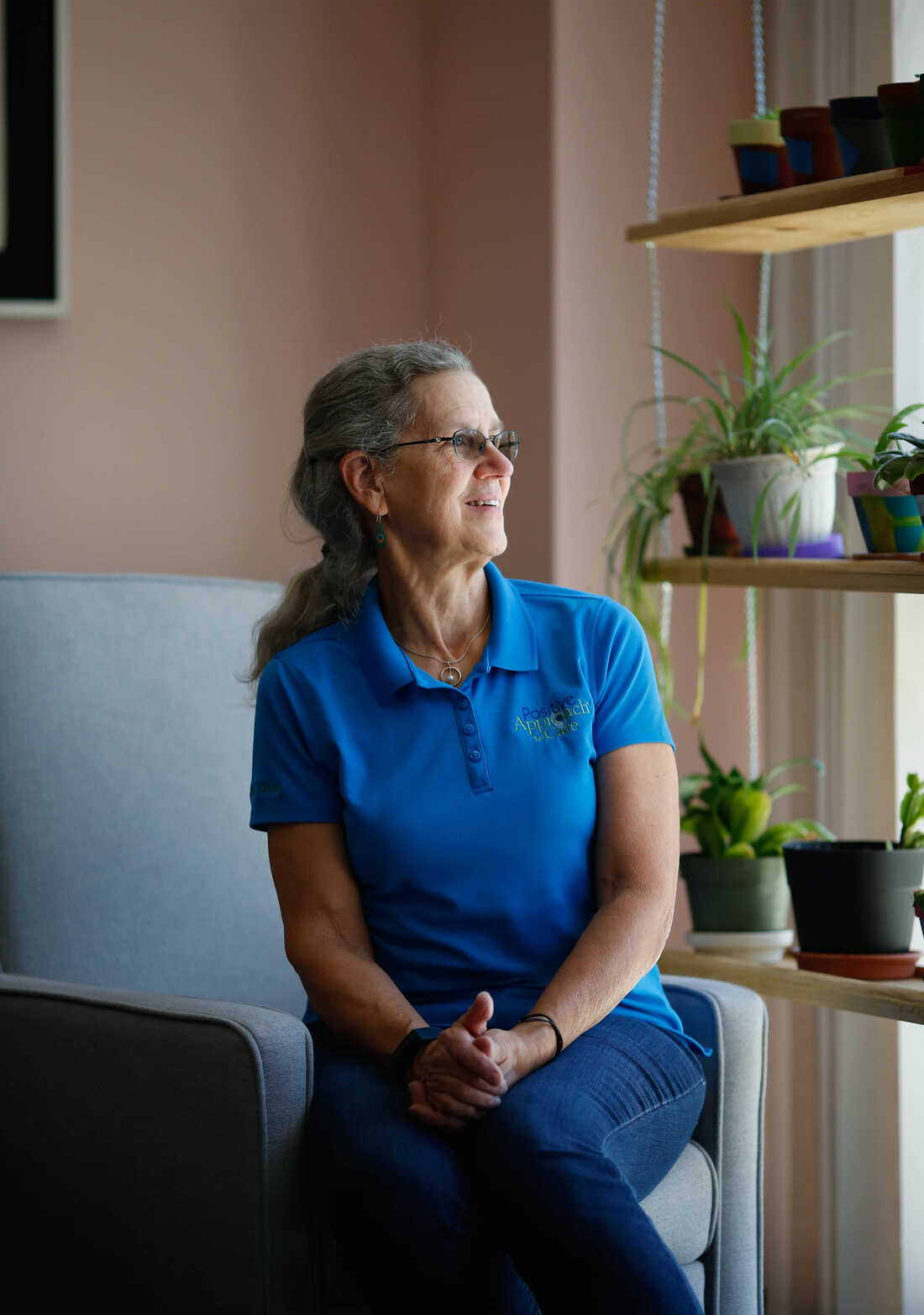
Snow is an occupational therapist with over 40 years of experience and author on the subject of managing care for dementia patients. She has more than 230,000 followers on TikTok.
Eamon Queeney for NPR
hide caption
toggle caption
Eamon Queeney for NPR
Because there’s no cure for Alzheimer’s or dementia, the medical community often treats dementia the way previous generations of practitioners treated cancer — like “a big black box,” Snow says. Decades ago, when people got cancer, “we didn’t say anything, we didn’t talk about it. We said, ‘Oh gosh, that’s horrible.’ And people were like, ‘…How long have they got?’ “
And while cancer is still a devastating diagnosis to receive, the medical community is more likely to respond by creating “a therapeutic alliance with the patient and the family,” says Portacolone, the UCSF professor.
But families of Alzheimer’s patients often report feeling like the medical system simply hands them an Alzheimer’s diagnosis, tells them there’s no cure, and essentially shows them the door. “[They’ll say] ‘You know, there’s really not a lot we can do,'” Snow explains. ” ‘You could read this book about the origin [of dementia.]’ It’s like, the last thing I need is another book to read.”
What family members need from the medical system, Snow says, is more understanding of symptoms and how to handle them, more help setting up long-term support systems, and knowledge about how patients can be helped by changes to their diet, sleep, exercise and lifestyle.
All too often, however, caregivers are left to muddle through and figure out the complex tasks of keeping a patient safe. ‘That’s pretty lonely,” Snow says. “And that’s so common. And at this point in time, if we had five families dealing with dementia, four out of five would fall apart before the disease was ended. And so that person who’s just chosen to be the primary [caregiver], they’re all alone. They’re truly all alone.”

Clients with dementia gather to learn dance movements at the adult day program. Amanda Bulgarelli, a Positive Approach to Care mentor, teaches the movements, then records the routine for TikTok. The post will serve as an example of Positive Approach to Care® techniques developed by Teepa Snow for interacting with those living with dementia.
Eamon Queeney for NPR
hide caption
toggle caption
Eamon Queeney for NPR
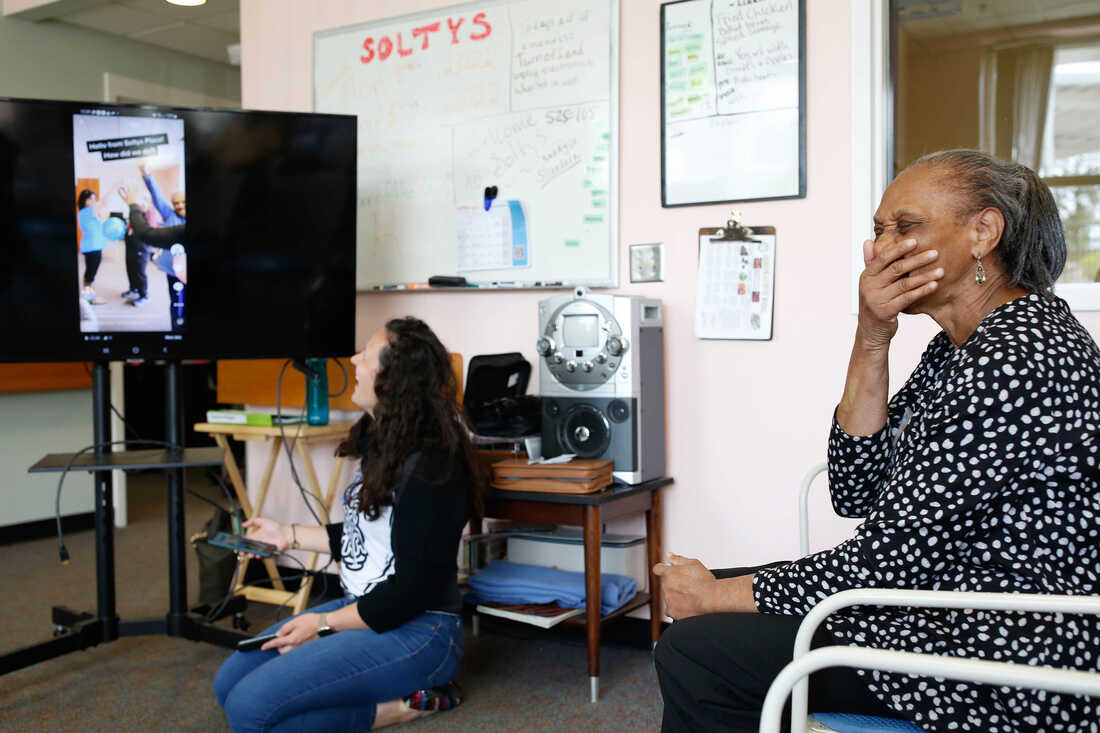
Ann Betts (right) reacts to a TikTok video that Amanda Bulgarelli (left) plays for her.
Eamon Queeney for NPR
hide caption
toggle caption
Eamon Queeney for NPR
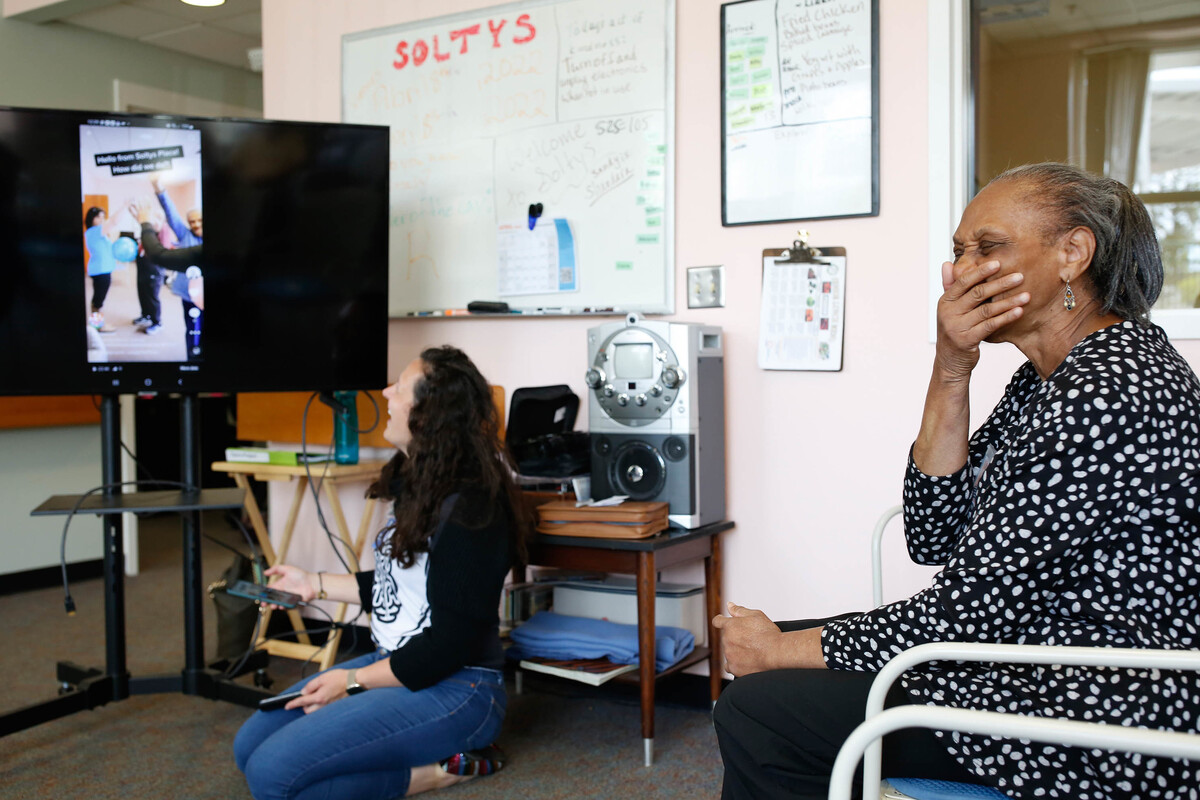
Ann Betts (right) reacts to a TikTok video that Amanda Bulgarelli (left) plays for her.
Eamon Queeney for NPR
Caregivers for people with dementia have been reaching out to one another for years, holding local in-person support groups or joining mega-groups on Facebook. There’s also no shortage of websites or books about the disease and the burdens of caregiving.
But the COVID pandemic disrupted or closed down many of those supports, such as in-person groups, or the adult daycare center that Revere’s mom had been attending five days a week. During lockdown, Revere noticed her mom’s condition started deteriorating. Desperate to keep her stimulated, and to find some kind of social connection for herself, Revere did what so many others did during COVID: She got on TikTok.
A single TikTok post of Snow’s can rack up millions of views. That’s because dementia TikTok, she says, is where “people are expressing an unmet need.”
Using TikTok feels like being submerged in an infinite torrent of videos — most about a minute long. But the short video format has attracted caregivers, who find they can document and share the vivid, daily moments of their homebound worlds in ways that would be less visceral on more text- or photo-centric platforms.
‘How many of us are on here?’
Just as you can watch videos showing World Cup highlights, you can also watch a woman’s “day in the life” video of caring for her husband with early-onset Alzheimer’s.
Or, perhaps, watching one of Revere’s @MomofMyMom posts from 2020, which walks viewers through their bath routine.
“It’s bath day,” Revere says at the start of the post, while still lying in bed. “I try my best not to make this an emotionally draining experience,” she sighs. “So let’s begin.”
Giving someone with dementia a bath can be difficult, or even dangerous. They can get disoriented, or feel threatened when someone takes off their clothes or maneuvers them into a wet tub. They may slip and fall, or try to physically fight their caregiver.
But Revere has created a soothing and predictable routine for her mother Lynn. At the time of this video, Lynn Hindmon is 63, and it’s about five years after her Alzheimer’s diagnosis. She’s not speaking much.
But in this video, Lynn Hindmon is still gorgeous: tall and regal, with great cheekbones. She still loves to pick out her own clothes, and on this day she’s wearing neon blue leggings and a purple beanie hat. She’s put on gold hoops and pink lipstick.
Revere starts off by promising her mom a present — which she’ll get after the bath.
“We’re going to get you some new lipstick. All right, let’s start.” Revere walks her audience through the process — sharing what works for them. She turns on some soul music, plugs in the space heater, puts the dog outside and lays out all her mom’s clothes. “Lure her into my cave,” she says, as her mom enters the bathroom.
The video then cuts to after the bath is over: Hindmon is dressed again, and mother and daughter are celebrating with a dance party in the bathroom.
“We dance and we dance and we dance,” Revere narrates. “And when we’re done, she gets a gift.” At last, Revere brings out the promised gift: a sleek black tube of lipstick.
“I have a present,” Revere tells her mom. Hindmon beams, but struggles to open the cap. “Here you go, it’s open,” Revere reassures her. “I opened it for you.”
Revere could not believe this video, of their regular bath routine, got more than 20,000 views. Hundreds of people left comments, saying how they can relate. One comment read: “My mother-in-law passed a year ago this week. This was the most frustrating part of caring for her. Devoted a whole day to getting this done). Another commenter told Revere “God Bless you! I know it’s hard. I see you and send so much love your way.”
It was then that Revere realized she was no longer so alone. All the burdens of caregiving — the house maintenance, the medical bills and insurance paperwork — were still very real. But she knew others were out there, struggling with the same chores and challenges. It was because of her TikTok channel, and the community it was helping her tap into. Revere posted a follow up right away:
“How many of us are on here?” she said into the camera. “I’ve been, like, looking for people my age that I can relate to, who have the same experience.”
TikTokers responded from as far away as South Africa. Revere’s following soared from just a couple thousand followers to more than 650,000. Many people used the comments to talk about their own caregiving struggles. They wanted to see the little victories, like her gentle and even joyful tricks for getting through bath time. But they also listened to Revere’s candid confessions and watched her struggle through moments of total exhaustion.
“Ya’ll, I have never been so emotionally drained in my life,” she shared in one video from February of last year. “Caregiving eats your soul. It kills your spirit. It’s constant mourning for years. … And it’s beautiful. And it’s said. Some days you just have to take it breath by breath.”
The ethical issue: Should we be showing dementia patients like this?
But the intimate, unvarnished depictions of dementia on TikTok dementia also raise unavoidable ethical issues involving privacy, dignity and consent. Because now the internet is littered with videos of adults who, for the most part, haven’t given conscious consent to their most vulnerable moments being shared with millions of strangers.
In one TikTok, a granddaughter chronicles her grandmother’s aggression, filming as the elderly woman chases her through the house, fists swinging wildly. Other accounts film the verbal abuse that caregivers can experience, or show Alzheimer’s patients in their most vulnerable moments: a distraught woman standing in her living room in a thin nightgown, pleading for her long-dead parents to come pick her up.
Beth Kallmyer, the vice president for Care and Support for the Alzheimer’s Association, doesn’t think the people posting these videos intend to be exploitative. “You could tell that the caregivers just felt isolated and frustrated and at their wit’s end, with no resources,” she says.
“If I were talking to a family member … considering doing this,” Kallmyer says, “those are the questions I would pose to them: Would they [the person with dementia] be comfortable with this? Is there a way for you to film something that gets the idea across but maintains their dignity and maintains their self-respect?”

A photograph of Hindmon now sits in Revere’s home in Inglewood, Calif., along with a Bible opened to Proverbs 31.
Lauren Justice for NPR
hide caption
toggle caption
Lauren Justice for NPR

A photograph of Hindmon now sits in Revere’s home in Inglewood, Calif., along with a Bible opened to Proverbs 31.
Lauren Justice for NPR
Public posts can potentially violate dignity in various ways, she explains. “Should we have a video of somebody that isn’t fully clothed? Or maybe [before Alzheimer’s] they only went outside when they were dressed to the nines or really put together, and you’ve got them in pajamas or sweatpants or whatever, and they don’t have makeup on. That’s about real … respect for the person. And I’m not sure that’s the best way to go about using TikTok.”
Some accounts have tried to directly address the issue of consent. The @TheKathyProject, for example, was created by sisters Kathy and Jean Collins to document the impacts and evolution of Kathy’s early-onset dementia diagnosis. In the early posts from 2020, Kathy’s symptoms are still fairly mild, and she’s clearly an eager participant in making and sharing the videos with the TikTok community.
Revere has a video that she now feels ambivalent about posting, in retrospect. Perhaps ironically, it’s the most-watched video on her channel, with 27 million views. In it, her mother is walking around the living room, holding an open bottle of mouthwash. She had somehow gotten past the locks on the bathroom cabinets.
Lynn Hindmon thinks the mouthwash is just a normal drink, like juice or milk. She looks frustrated and dazed as Revere tries to explain to her mom why she can’t drink mouthwash.
But Hindmon doesn’t want to let the mouthwash go. As caregivers know, Revere now has to keep this from escalating into a big conflict. “May I have it please? Please?” she asks her mom, who eventually relents and hands it over.
“Thank you so much, and I’m going to exchange it for something that tastes even better, all right?” Revere gets her mom a popsicle.
But some of the comments on that post were cruel, calling her mom an alcoholic, or saying she looked scary. The experience made Revere feel protective — like she needed to be more careful, as she didn’t want to post anything that might put her mom in a bad light. Still, after much consideration, she decided to keep the mouthwash video up. She says it’s still a good example of “redirecting” away from a risk — something other caregivers would understand.
Life after caregiving
On March 9, Jacquelyn Revere posted another video on TikTok.
“Hey ya’ll, I just wanted to come in and tell ya’ll that, that Mommy passed. She passed on Sunday night. … And it was, it was a really hard experience. And that’s really all I have for now. So lift us up in prayer. Send us your condolences. But Mommy is dancing up in heaven right now.”
Lynn Hindmon had collapsed suddenly at home on the evening of March 6. She died of cardiac arrest at the age of 65. On Tik Tok, the messages of surprise and condolence poured in.
“There were people who tuned in … to literally just watch Mommy eat in the morning, and then whatever we did at lunch time,” Revere says. “And people became a part of our family. People cried. People have been so touched by this story and have mourned my mom in a way that I never would have expected.”
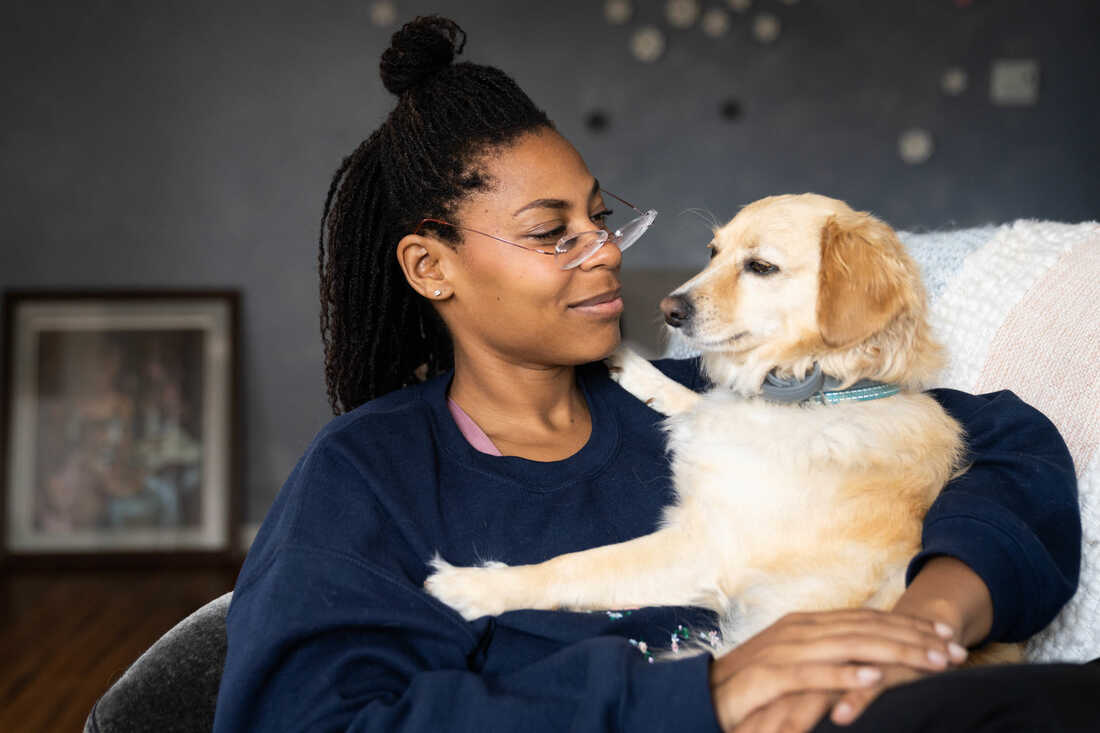
Revere’s mother died in March, after six years of living with Alzheimer’s. Revere received an outpouring of support from the community on TikTok — people who had watched her videos and connected with her and her mom. Now, Revere is figuring out who she is after years of caregiving. Her dog Dewey has made appearances in her TikTok videos.
Lauren Justice for NPR
hide caption
toggle caption
Lauren Justice for NPR
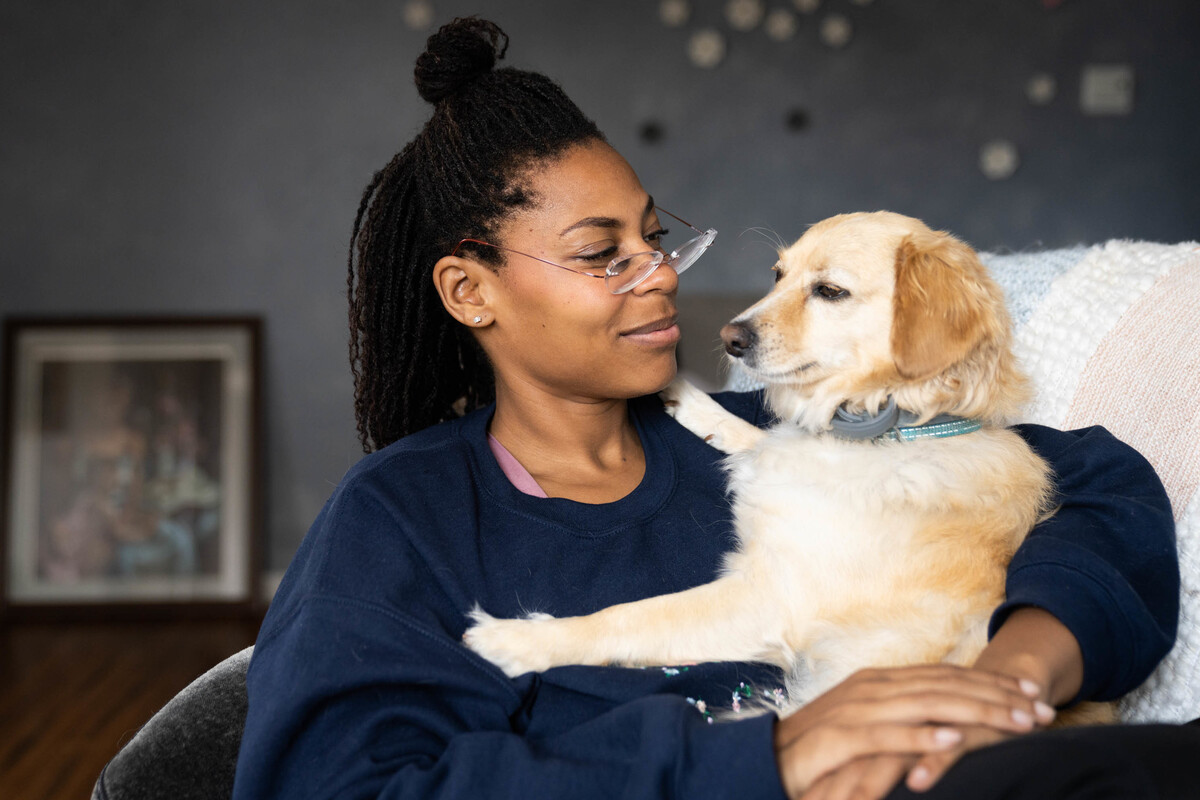
Revere’s mother died in March, after six years of living with Alzheimer’s. Revere received an outpouring of support from the community on TikTok — people who had watched her videos and connected with her and her mom. Now, Revere is figuring out who she is after years of caregiving. Her dog Dewey has made appearances in her TikTok videos.
Lauren Justice for NPR
For Revere, an only child, she’d always assumed that when her mom died, she’d have to mourn her alone. Instead, people were checking in on her, sending her gifts, sharing memories of their favorite videos of Lynn.
“It’s been the least lonely I’ve ever been throughout this experience actually,” she says. “It’s not just my lonely journey anymore. Now it’s everyone’s.
Revere has continued to post on @MomofMyMom. Recently she’s been posting about her grief. In videos, she talks about what it feels like to miss her mom, and to mourn the life she didn’t live while she was caring for her.
Now she has all the time in the world. She can go on dates. She can take her dog, Dewey, to the dog park again, let him lean out the open window in the car. Go out for a pedicure or drive by the ocean. But it’s been hard to let herself do these things, she tells her followers. Because what they mean is that her mom is gone.
After six years of caring for her mom, starting when she was just 29, Revere is now trying to figure out who she is now — and what she wants. She knows she wants to stay connected with dementia caregivers, especially the ones who don’t have huge followings, or who don’t get thousands of comments about what a good job they’re doing.
“I just want them to know that they’re being thought about,” Revere says. “Because that’s what I needed most. Just to know that life isn’t passing me by, and I’m not seen.”
“I just want to make sure that they feel seen.”
Source by www.npr.org
