
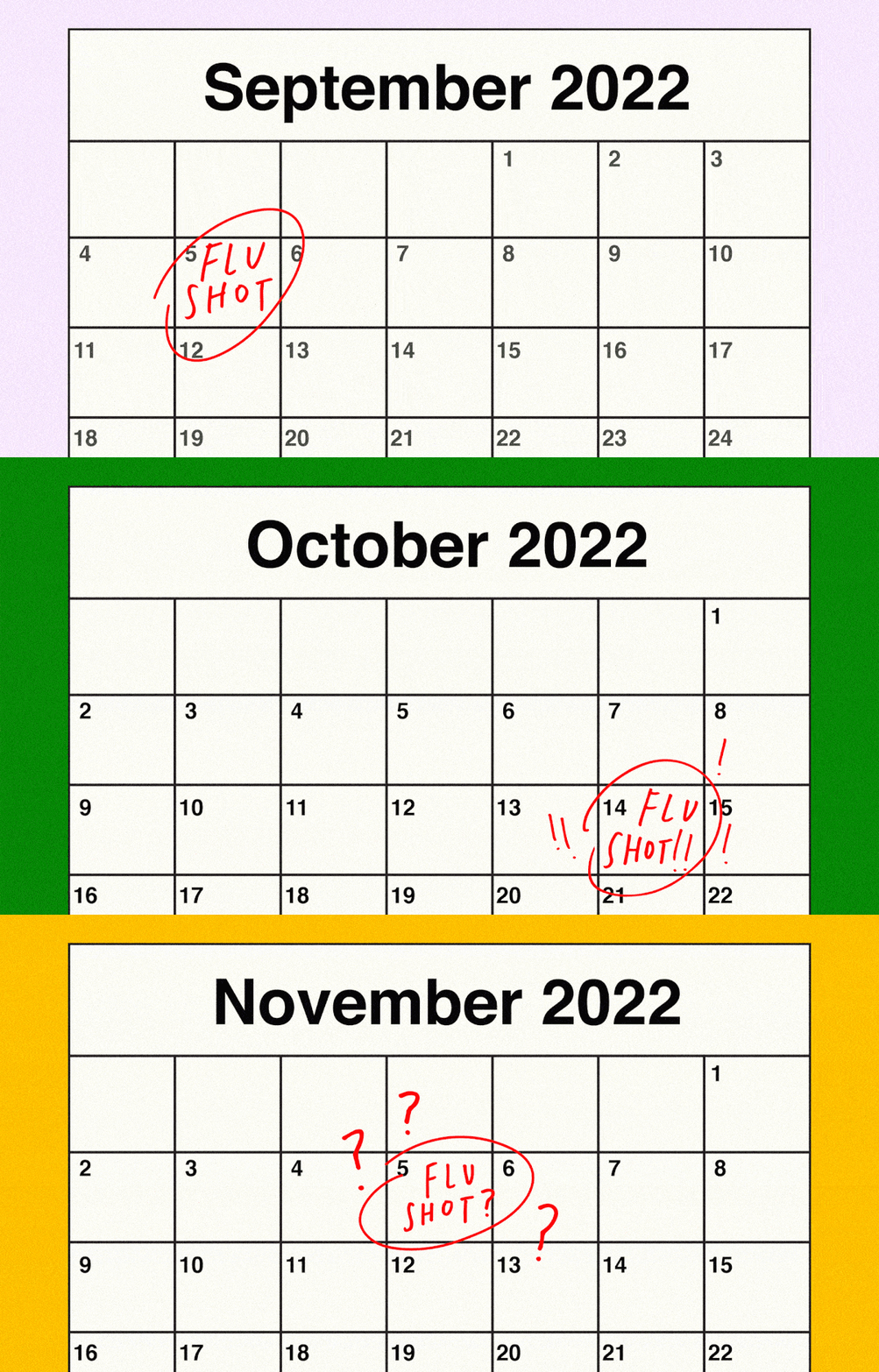
For about 60 years, health authorities in the United States have been championing a routine for at least some sector of the public: a yearly flu shot. That recommendation now applies to every American over the age of six months, and for many of us, flu vaccines have become a fixture of fall.
The logic of that timeline seems solid enough. A shot in the autumn preps the body for each winter’s circulating viral strains. But years into researching flu immunity, experts have yet to reach a consensus on the optimal time to receive the vaccine—or even the number of injections that should be doled out.


Each year, a new flu shot recipe debuts in the U.S. sometime around July or August, and according to the CDC the best time for most people to show up for an injection is about now: preferably no sooner than September, ideally no later than the end of October. Many health-care systems require their employees to get the shot in this time frame as well. But those who opt to follow the CDC current guidelines, as I recently did, then mention that fact in a forum frequented by a bunch of experts, as I also recently did, might rapidly hear that they’ve made a terrible, terrible choice.
“There’s no way I would do what you did,” one virologist texted me. “It’s poor advice to get the flu vaccine now.” Florian Krammer, a virologist at Mount Sinai’s Icahn School of Medicine, echoed that sentiment in a tweet: “I think it is too early to get a flu shot.” When I prodded other experts to share their scheduling preferences, I found that some are September shooters, but others won’t juice up till December or later. One vaccinologist I spoke with goes totally avant-garde, and nabs multiple doses a year.
There is definitely such a thing as getting a flu shot too early, as Helen Branswell has reported for Stat. After people get their vaccine, levels of antibodies rocket up, buoying protection against both infection and disease. But after only weeks, the number of those molecules begins to steadily tick downward, raising people’s risk of developing a symptomatic case of flu by about 6 to 18 percent, various studies have found. On average, people can expect that a good portion of their anti-flu antibodies “are meaningfully gone by about three or so months” after a shot, says Lauren Rodda, an immunologist at the University of Washington.
That decline is why some researchers, Krammer among them, think that September and even October shots could be premature, especially if flu activity peaks well after winter begins. In about three-quarters of the flu seasons from 1982 to 2020, the virus didn’t hit its apex until January or later. Krammer, for one, told me that he usually waits until at least late November to dose up. Stanley Plotkin, a 90-year-old vaccinologist and vaccine consultant, has a different solution. People in his age group—over 65—don’t respond as well to vaccines in general, and seem to lose protection more rapidly. So for the past several years, Plotkin has doubled up on flu shots, getting one sometime before Halloween and another in January, to ensure he’s chock-full of antibodies throughout the entire risky, wintry stretch. “The higher the titers,” or antibody levels, Plotkin told me, “the better the efficacy, so I’m trying to take advantage of that.” (He made clear to me that he wasn’t “making recommendations for the rest of the world”—just “playing the odds” given his age.)
Data on doubling up is quite sparse. But Ben Cowling, an epidemiologist and flu researcher at Hong Kong University, has been running a years-long study to figure out whether offering two vaccines a year, separated by roughly six months, could keep vulnerable people safe for longer. His target population is Hong Kongers, who often experience multiple annual flu peaks, one seeded by the Northern Hemisphere’s winter wave and another by the Southern Hemisphere’s. So far, “getting that second dose seems to give you additional protection,” Cowling told me, “and it seems like there’s no harm of getting vaccinated twice a year,” apart from the financial and logistical cost of a double rollout.
In the U.S., though, flu season is usually synonymous with winter. And the closer together two shots are given, the more blunted the effects of the second injection might be: People who are already bustling with antibodies may obliterate a second shot’s contents before the vaccine has a chance to teach immune cells anything new. That might be why several studies that have looked at double-dosing flu shots within weeks of each other “showed no benefit” in older people and certain immunocompromised groups, Poland told me. (One exception? Organ–transplant recipients. Kids getting their very first flu shot are also supposed to get two of them, four weeks apart.)
Even at the three-ish-month mark past vaccination, the body’s anti-flu defenses don’t reset to zero, Rodda told me. Shots shore up B cells and T cells, which can survive for many months or years in various anatomical nooks and crannies. Those arsenals are especially hefty in people who have banked a lifetime of exposures to flu viruses and vaccines, and they can guard people against severe disease, hospitalization, and death, even after an antibody surge has faded. A recent study found that vaccine protection against flu hospitalizations ebbed by less than 10 percent a month after people got their shot, though the rates among adults older than 65 were a smidge higher. Still other numbers barely noted any changes in post-vaccine safeguards against symptomatic flu cases of a range of severities, at least within the first few months. “I do think the best protection is within three months of vaccination,” Cowling told me. “But there’s still a good amount by six.”
For some young, healthy adults, a decent number of flu antibodies may actually stick around for more than a year. “You can test my blood right now,” Rodda told me. “I haven’t gotten vaccinated just yet this year, and I have detectable titers.” Ali Ellebedy, an immunologist at Washington University in St. Louis, told me he has found that some people who have regularly received flu vaccines have almost no antibody bump when they get a fresh shot: Their blood is already hopping with the molecules. Preexisting immunity also seems to be a big reason that nasal-spray-based flu vaccines don’t work terribly well in adults, whose airways have hosted far more flu viruses than children’s.
Getting a second flu shot in a single season is pretty unlikely to hurt. But Ellebedy compares it to taking out a second insurance policy on a car that’s rarely driven: likely of quite marginal benefit for most people. Plus, because it’s not a sanctioned flu-vaccine regimen, pharmacists might be reluctant to acquiesce, Poland pointed out. Double-dosing probably wouldn’t stand much of a chance as an official CDC recommendation, either. “We do a bad enough job,” Poland said, getting Americans to take even one dose a year.
That’s why the push to vaccinate in late summer and early fall is so essential for the single shot we currently have, says Huong McLean, a vaccine researcher at the Marshfield Clinic Research Institute in Wisconsin. “People get busy, and health systems are making sure that most people can get protected before the season starts,” she told me. Ellebedy, who’s usually a September vaccinator, told me he “doesn’t see the point of delaying vaccination for fear of having a lower antibody level in February.” Flu seasons are unpredictable, with some starting as early as October, and the viruses aren’t usually keen on giving their hosts a heads-up. That makes dillydallying a risk: Put the shot off till November or December, and “you might get infected in between,” Ellebedy said—or simply forget to make an appointment at all, especially as the holidays draw near.
In the future, improvements to flu-shot tech could help cleave off some of the ambiguity. Higher doses of vaccine, which are given to older people, could rile up the immune system to a greater degree; the same could be true for more provocative vaccines, made with ingredients called adjuvants that trip more of the body’s defensive sensors. Injections such as those seem to “maintain higher antibody titers year-round,” says Sophie Valkenburg, an immunologist at Hong Kong University and the University of Melbourne—a trend that Ellebedy attributes to the body investing more resources in training its fighters against what it perceives to be a larger threat. Such a switch would likely come with a cost, though, McLean said: Higher doses and adjuvants “also mean more adverse events, more reactions to the vaccine.”
For now, the only obvious choice, Rodda told me, is to “definitely get vaccinated this year.” After the past two flu seasons, one essentially absent and one super light, and with flu-vaccination rates still lackluster, Americans are more likely than not in immunity deficit. Flu-vaccination rates have also ticked downward since the coronavirus pandemic began, which means there may be an argument for erring on the early side this season, if only to ensure that people reinforce their defenses against severe disease, Rodda said. Plus, Australia’s recent flu season, often a bellwether for ours, arrived ahead of schedule.
Even so, people who vaccinate too early could end up sicker in late winter—in the same way that people who vaccinate too late could end up sicker now. Plotkin told me that staying apprised of the epidemiology helps: “If I heard influenza outbreaks were starting to occur now, I would go and get my first dose.” But timing remains a gamble, subject to the virus’s whims. Flu is ornery and unpredictable, and often unwilling to be forecasted at all.
Source by www.theatlantic.com
