
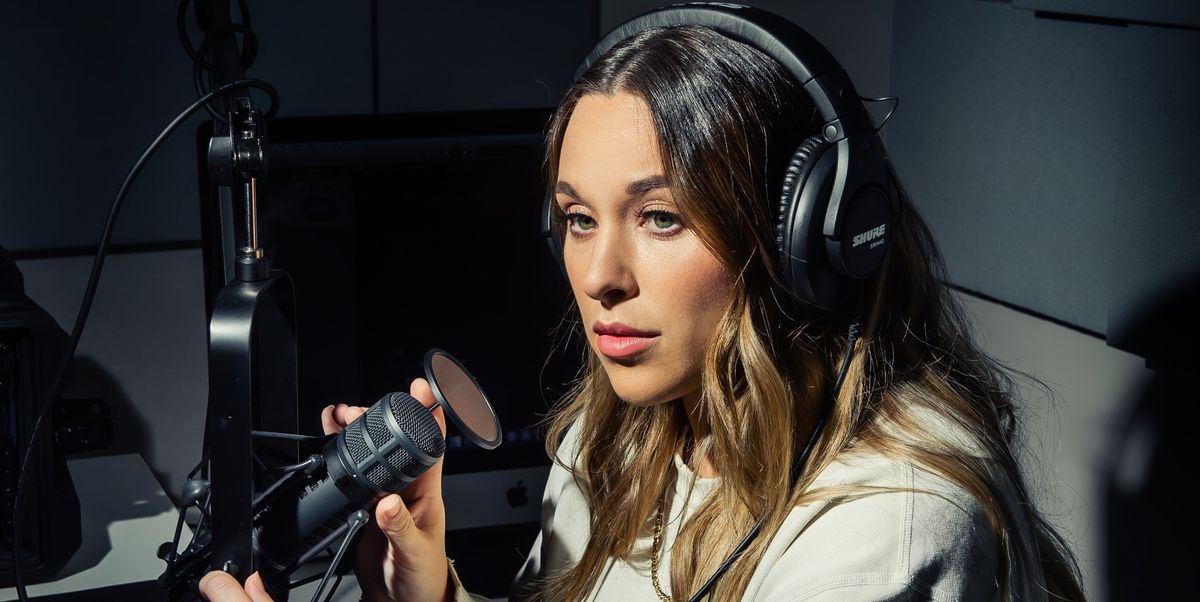
When Ashley Flowers was a child, she wanted to be a defense attorney. Once she realized the job wasn’t like it appeared on TV, she decided to be a cold case detective. “Then I found out you had to be a cop, and I was like, hard pass,” she said. As long as she could remember, she’d had an insatiable appetite for true crime. “But until podcasting, I never found the thing I was good at.” She released the first episode of the weekly podcast she cohosts, Crime Junkie, in December of 2017. The format involved Flowers recounting the details of a crime she’d researched online to her best friend, Brit Prawat, who interjected questions, asides, or midwesternisms like “Oh my word!” Flowers started out recording the show at home in an extra bedroom (with Prawat, who lives in South Bend, Indiana, on the telephone). Prawat’s husband composed the theme song, doing his best to interpret what Flowers meant when she asked for it to be “pingier”; Flowers’s younger brother, David, then a college student, took on the editing the following summer.
Within a year, Rolling Stone had declared Crime Junkie one of the best true crime podcasts of 2018. By mid-2019, Flowers and Prawat were on a panel at CrimeCon, the conference that draws everyone from serial killer obsessives to victims’ advocates to journalists trying to figure out what to make of the fact that so many attendees—mostly white, largely women—rank it, at least according to CrimeCon, as “one of the best weekends of my life!” In October 2021, the company signed a multiyear ad sales deal with SiriusXM, reportedly worth more than $100 million. As of this spring, Crime Junkie was the second-most-listened-to podcast in the country, topped only by Joe Rogan, according to Edison Research. Through part of June, shows put out by Flowers’s company, Audiochuck (it’s named after her dog, Chuck), held three of the top 10 spots on the Apple podcast charts. Audiochuck’s website claims its podcasts get 52 million downloads a month.
Since Flowers entered the true crime podcast industry, it has grown exponentially. There are now numerous highbrow shows investigating the shortcomings of the criminal justice system; a wide array of “true crime comedies”; and over 100 episodes (I stopped counting) dedicated to Gabby Petito, the woman killed by her fiancé while they were traveling across the country last summer. That so many people, particularly women, are consuming true crime has prompted curiosity and consternation. It’s not entirely clear whether this interest is new—is it more than after the Manson murders? Or during the era of Jack the Ripper?—but what is apparent is that Flowers has uncanny insight into the types of stories many Americans want right now. Along the way, she has amassed one of those complicated fandoms consisting of lots of people who like what she does and a fair number who don’t, but who still tune in anyway. (On the Crime Junkie subreddit, posters alternately defend the show or their right to criticize, and continue listening to, a show they seem to genuinely dislike.) When Flowers announced earlier this year that she would be publishing her first crime novel in August—All Good People Here—it rose to the top 10 list on Amazon’s charts. On Goodreads, reviewers began declaring their approval with the catchphrase Crime Junkie is known for: “FULL. BODY. CHILLS.”
Flowers and her dog, Chuck, for whom her company, Audiochuck, is named.
Dina Litovsky
Over the last few years, she’s also encountered the perils and opportunities of a space with few set rules, not to mention the pitfalls of engaging with a subject that, even if huge amounts of money weren’t sloshing around, would be morally fraught. It turns horrific experiences into entertainment, but at the same time, some victims’ families proactively seek out coverage. As the ethical complications have become more salient, they have prompted a reckoning. But how exactly they could ever be fully resolved remains an open question.
Spotify’s new complex in downtown L.A. is so large it’s known as “Pod City.” SiriusXM, which acquired Stitcher in 2020 through a deal worth close to $325 million, has its headquarters in New York’s Rockefeller Center. Audiochuck’s office is in Broad Ripple, a residential neighborhood in Indianapolis. One morning in May, I arrived at a coffee shop there to find Flowers standing outside in the kind of stretchy black dress that makes breastfeeding easier—she gave birth to her daughter, Josie, in January. She held Chuck’s leash in one hand and, in the other, an iced coffee she’d likely leave somewhere around the office. “They call me the drink phantom,” she said.
People also call her “driven.” She spent Audiochuck’s early years working 80 hours a week, sometimes arriving at the office at 4:30 a.m. to start walking at a treadmill desk. After Josie’s birth, Flowers took two weeks off, then returned part-time for a month; ever since, she’s worked 50-hour weeks. This was as much about necessity as about the fact that Audiochuck, in those blurry days of new motherhood, was a lifeline. Early on, Flowers experienced postpartum depression and struggled to bond with Josie. “Now I’m obsessed with her, but it was hard at first,” she said. “Work made me feel I was at least good at something.”
Across from the coffee shop was a large, modern space with enormous windows that the company planned to move into soon. By comparison, the current office, a few blocks away, included a galley kitchen that opened to a larger room with a cluster of desks, boxes of merchandise, and a map of the world to keep track of places fans had reached out from (pins were stuck in almost every country). Most of the roughly 30 employees were women, but there was one windowless room housing two male audio engineers—the “bro cove,” David called it.
As it became clear they were outgrowing that office, Flowers considered, briefly, opening one in L.A. “But I hated feeling like if I wanted a job in the entertainment space, I had to go to New York or L.A.,” Flowers said. (“We’re Midwesterners,” Prawat told the New York Times last February. “We put ranch on everything.”)
“You always assume nothing bad is going to happen to you or your family,” the point being that, of course, it always could. “It’s a weird way to look at the world,” Flowers says.
When Flowers began plotting her novel, which she collaborated on with another writer named Alex Kiester, she situated it in the Midwest, too. A taut mystery, it tells the story of a journalist, Margot, who returns home to Wakarusa, Indiana (Prawat’s hometown), to care for her aging uncle and ends up investigating two murders. The plot twists, broadly, around the idea that danger could lurk anywhere—a theme often referenced on Crime Junkie. “The second you leave your guard down, you can succumb to a predator,” as Flowers said in one episode. “You always assume nothing bad is going to happen to you or your family,” she said in another, the point being that, of course, it always could. “It’s a weird way to look at the world,” she told me as we sat in her office. “Even with people I think I know, I don’t know what happens behind closed doors.”
Flowers, who’s never experienced crime herself, believes learning about it can help people avoid it, or at least know how to respond. The Crime Junkie episode she’s most proud of featured a woman who, after her sister went missing, used skills she gleaned partly from Crime Junkie to investigate. What often came across when I listened to Crime Junkie, though, was how random crime could be, and how difficult to foresee. While Flowers encourages listeners to follow their instincts, the stories frequently reveal how our instincts can fail us.
The night before, after listening to hours of true crime, I felt so nervous in my hotel room that I checked not only the locks but, inexplicably, all the drawers. Walking through Broad Ripple the next day—the sky bright blue and everything blooming in that lush mid-spring way that makes it easy to imagine that nothing will ever die—my fears seemed absurd. I was with two publicists who represent Audiochuck, and one suggested the neighborhood reminded her of Gilmore Girls. “It seems like the kind of place where nothing bad ever happens,” said the other.
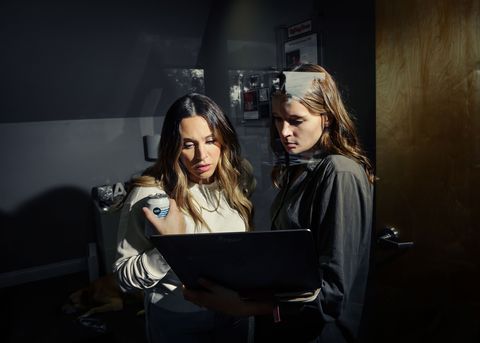
Flowers and her best friend and cohost, Brit Prawat.
Dina Litovsky
A few weeks earlier, Flowers was at the office when Prawat’s husband texted to say Prawat was in the hospital—she’d had a blood clot in her brain and was soon rushed into surgery. Flowers dropped everything and drove to South Bend. When she announced what happened on Crime Junkie, she sobbed, though she said the prognosis was positive.
The two have known each other since they were babies. After Flowers’s mom, Lisa, gave birth to her, Prawat’s mother, a close friend, visited the hospital. Lisa, wanting to be encouraging—Prawat’s parents were trying to adopt—said, “For all you know, your baby could be being born right now.” Two months later, when Prawat’s parents adopted her, they learned she had in fact been born that day.
Both families were part of the same megachurch—Flowers’s dad was an associate pastor, so her family lived in a parsonage on church property. The community was patriarchal and regimented; anything occult was frowned upon, as was alcohol. Flowers said that cigarettes got you sent to hell. “We had to go to church three days a week,” she said. “It was my whole world.” (Flowers was homeschooled for part of elementary school and attended the church’s school for junior high.) As children, Flowers and Prawat were both also drawn to mysteries. JonBenét Ramsey was the first true crime they were aware of—they were “tabloid height” at the time, Flowers said.
When the girls were in their early teens, the church had a schism. “I think that kind of opened everyone’s eyes,” Flowers said. She came to believe the church taught judgment, not love. “People who buy into those [ideas] really believe what they’re told, which is that they’re trying to save people from eternal damnation,” she said. “But it’s so fear-based.” Still, certain values she retained. “There were kooky things from the church, but some good, too,” Lisa said (she and Flowers’s dad divorced in 2019). “We were taught to always be looking for a need.” Having such a disillusioning experience could make trusting others challenging. This was also useful in true crime, Flowers said.
Flowers attended college in Arizona, living with her grandmother while going to night school and working as a hospital telephone operator “with six other women who were all in their sixties,” she said. Once she transferred to another job, she made a friend around her age, Amber Wong, who shared her love of true crime. When work was slow, they’d read from an online library of true crime cases. “People thought we were pretty odd,” Wong said. “We’d read for hours.”
Flowers still had no idea how to turn this interest into a career, though. One of her first jobs out of college was in genetic research at the University of Notre Dame. After that, she worked in sales at a medical start-up. This involved a lot of driving, which led to her bingeing the audio series Serial, sparking her obsession with true crime podcasts. She found her next job, at a software development company, by Googling Indianapolis companies that let you bring dogs to work. She also began volunteering for a local Crime Stoppers chapter. “[I started to have] this lingering question,” she said. “If this was my sister, would I want people being like, ‘Oh, this is so interesting,’ then moving on? At least if I was volunteering, I was trying to give back.”
“Journalists do a ton of work, and I want to make sure they get credit. So we had to have this pivoting moment.”
At Crime Stoppers, Flowers was tasked with trying to spread brand awareness to more people her age. She ended up meeting a local radio host, who suggested they work together on a true crime segment. The result was “Murder Monday.” “I would do the research, wake up at 5 a.m., come into the station, and tell a story,” Flowers said. The segment did so well that she decided to create her own podcast. It never occurred to Flowers to do the show with anyone other than Prawat. “That’s always been our dynamic,” Flowers said. “I’m the big ideas, and she’s like, ‘I’m here to support you, man.’”
Flowers invested $13,000, the bulk of her savings, to launch Crime Junkie. She slapped magnets on her car, and taped cards to bathroom stalls at rest stops. Prawat, on air, was meant to represent the audience, basically playing the role of sidekick. Prawat quit her day job first (she was in the office of a logistics company); Flowers followed soon after.
In August 2019, a journalist named Cathy Frye, upon hearing Crime Junkie’s episode about a crime she’d covered for the Arkansas Democrat-Gazette, left an incensed comment on Flowers’s Facebook page: “You quoted a portion of MY copyrighted story almost verbatim,” Frye wrote. “I then started listening to your other podcasts and—SURPRISE!—discovered that you don’t cite sources or credit news organizations.” BuzzFeed News and Variety wrote stories about the plagiarism accusations, and other press followed.
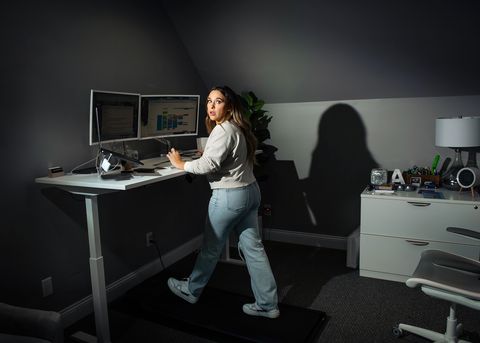
Flowers walking at a treadmill desk.
Dina Litovsky
At the time, there were few established standards for true crime podcasts. Speaking about the industry in general, Variety wrote in 2019, “It’s not unusual for some podcasters to, say, simply read whole passages from Wikipedia.” (A few months earlier, when an interviewer asked Flowers, “Where do you find all of this—Wikipedia?” she responded, “God, no, that would make us like some of the podcasts I don’t love.”) Flowers called herself a storyteller, as opposed to a journalist, and acknowledged drawing from others’ research. “In my mind, I was like, I’m so clear on the show this is not my original [reporting],” she said. “I thought that was enough.” She often didn’t say whose it was, though. “Once it was brought to my attention, of course it’s not enough,” Flowers added. “Journalists do a ton of work, and I want to make sure they get credit. So we had to have this pivoting moment.”
Flowers pulled a number of episodes, including the one that drew on Frye’s work, and later reuploaded them with notes listing her sources. What the coverage also brought to light, though, was other true crime podcast hosts who claimed Flowers paraphrased their work. (Flowers said she simply used the same primary sources: “I didn’t take anyone’s work and make it my own.”) More recently, at least one true crime podcast made Flowers the focus of an episode, with her suspected transgressions discussed in the same dramatic tones the hosts used to discuss murder.
As this was unfolding, Flowers was preparing to release Red Ball, a podcast about a detective, Bill Dalton, newly in charge of a locally notorious 40-year-old unsolved case. This proved controversial, too, after it came out that Dalton had given Flowers information from case files, even as another true crime podcast host, per Indianapolis Monthly, had an open records request for case documents denied. (“I was not allowed to sit in a room with the files by myself,” Flowers said, though she acknowledged looking over certain things with Dalton.) Flowers also gave Dalton final approval over what would be included; the true crime podcast The Murder Sheet later described Red Ball as “badly written ‘copoganda.’”
Perhaps women like “creepy stories because something creepy [is] in us.”
In some episodes of Crime Junkie, law enforcement comes off badly. “There are stories where the officers are pushing these cases forward,” Flowers said. “But there are a boatload where they’re actively getting in the way or treating people differently because of who they are.” Nonetheless, the show has often been credulous regarding law enforcement claims. In its episode on the 2009 disappearance of a white teenage girl, Crime Junkie named the young Black man whom the FBI had declared a suspect; recently another man (white, older) reportedly confessed to the crime and was charged with her murder. When I asked Flowers if she thought Crime Junkie erred in its coverage, she said she still wasn’t sure. “Obviously he was responsible for nothing,” she said of the young man. “But if police are trying to elicit information about a person, the public needs to know their name. I wish I had a good answer. The answer is, we have to figure out how to do better.”
Drill down into some of the statements about true crime, and they start to seem facile. “True crime isn’t having its moment; it’s always been popular,” said Kelli Boling, an assistant professor of advertising and public relations at the University of Nebraska–Lincoln. “The difference now is you can say how many people are downloading it.” In terms of demographics, a 2019 CivicScience study found that viewership of true crime TV and documentary series skewed only slightly female. When it comes to true crime podcasts, though (or even shows like CSI), they clearly draw more women—one 2018 study coauthored by Boling found 73 percent of true crime podcast listeners were women.


As to why, “the research isn’t particularly strong,” said Louise Wattis, a criminologist at Northumbria University; the reasons women consume true crime are not always clear even to those who themselves listen to it. Boling wrote her PhD dissertation on domestic violence survivors who love true crime podcasts; many subjects asked her to let them know if she figured out why. (It seemed, at least partly, to be therapeutic.) One 2010 study suggested women believe true crime helps them learn to avoid predators. Journalist Rachel Monroe wrote in her book Savage Appetites that perhaps women like “creepy stories because something creepy [is] in us.” Maybe women are drawn to the possibility of becoming self-deputized internet detectives, or maybe it’s because women fear crime more—if you spend a lot of your life scared of something, you’re likely, when given the opportunity, to want a closer look. (Despite this, women are far less likely to be murdered than men, and have about the same chance, per Statista, of being the victim of a violent crime.)
Considered from a different angle, though, why would women consuming true crime content be perplexing? True crime tales are stories in the classic sense, with a mystery introduced in the beginning and, one hopes, a resolution at the end. They reveal the darker corners of the human psyche, and often the secrets of another person’s life, hardly topics of niche interest.
It seems plausible the response to the genre might be different if it weren’t so associated with women. But at the same time, there are lots of reasonable criticisms—true crime podcasts do inevitably prey on people’s suffering, and the victims portrayed are disproportionately white middle-class women. “I think a wave of accountability is brewing,” said Sarah Turney, who hosts the podcast Voices for Justice. Turney got into the industry after doing dozens of podcast interviews trying to get attention for her sister’s 2001 disappearance. Yet while Turney guessed that podcasts could have made in the six figures from her sister’s story, she found herself struggling to raise $6,000 on a GoFundMe for billboards she hoped would prompt leads. Turney said hosts have even asked her to cry, as in, ‘Can you work up a few tears? I think we’ll get more downloads.’” (After Turney approached Flowers to see if she’d cover her sister’s case, Crime Junkie ran an episode about her. Turney and Flowers subsequently became so close that Flowers has hosted Turney for Christmas.)
The women Boling interviewed for her dissertation were partial to Crime Junkie because they saw themselves reflected in it and felt it was respectful of the victims and stuck with the facts. But this isn’t how it’s universally perceived. In Frye’s Facebook post, she described the show as taking a “coffee-chat, gossipy approach.” While it doesn’t feature much speculation, there is some, and though Flowers and Prawat don’t joke about crimes, they do make what are meant to be funny asides. Then there are the stories involving “pruppets,” Flowers’s term for dogs (she repurposed it from an Adult Swim sketch about puppets). In one episode, after Flowers mentioned a police dog who placed his paw on his former owner’s casket, Prawat exclaimed, “This might be the first episode where I cry!” (Despite seeming off-the-cuff, the show is mostly scripted.)
In recent years, Flowers has focused heavily on advocacy, starting a nonprofit, Season of Justice, that funds advanced DNA testing (so far Audiochuck has donated $800,000). She tries not to cover a case, she said, unless she believes it can serve a positive purpose, whether by increasing awareness or prompting tips. In 2021, she also hired a reporter so that Crime Junkie could dig into cases that have received little attention. For 2022, she aims to have at least 30 percent of Crime Junkie victims be from marginalized communities. “I’m trying to figure out how to do this ethically,” she said. But as she also acknowledged, “It’s not black and white.” Brittany Bigelow, Audiochuck’s head of production, explained that they considered entertainment and advocacy as inextricably linked. Without advocacy, they were simply exploiting trauma for profit; without entertainment, listeners wouldn’t be motivated to engage.
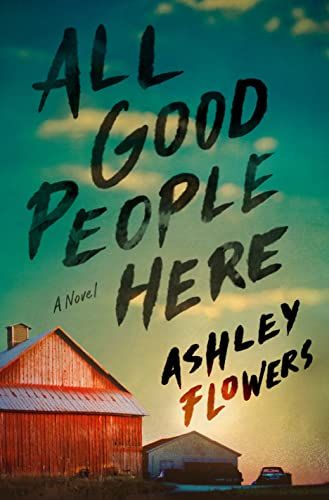
Bantam All Good People Here: A Novel
Now 14% Off
That May afternoon at the Audiochuck office, a small group convened for a meeting. “We have a thousand things to cover and five minutes to do it,” Flowers said. “Which is our specialty,” Bigelow said. Over the next 40 minutes, they ran through upcoming episodes. For one, they planned to provide listeners with a template they could use to encourage a state attorney general to change a victim’s cause of death from “undetermined” to “homicide.” For another, they discussed putting up a billboard. After I left the office, I listened to the episode about the woman, Emily Corbin, who’d used her “Crime Junkie skills” to investigate her sister’s disappearance. In many respects, it served as a justification for Audiochuck’s approach; it suggested that, whatever the ethical complications, it was helping in tangible ways. Corbin wasn’t able to stop her sister from being murdered, but she did help lead police to the killer.
Flowers’s novel ended in a less conclusive fashion, answering some questions and raising a lot of others. I assumed she’d finished with a cliffhanger because she planned to write a sequel, but she said she didn’t. “I wanted readers to walk away feeling unease, because that represented the world that I live in,” she said. “So many times, you don’t figure out what happened. Or if you do, you still don’t get why.”
That a lot of true crime stories told today reflect such uncertainties is relatively new—it used to be most concluded the way Corbin’s did, with the killer caught and justice, on some level, restored. At the same time, Corbin’s case itself was an unsettling indictment: No one was coming to save her sister; she had to do it herself. As for Flowers, she has spent too much time learning about crime not to recognize that, in many situations, even getting an answer—a grim best-case scenario—was unlikely. “You want to bring order back to something that doesn’t feel like it makes sense,” she said. “You want to put all the pieces back together. But they don’t always fit.”
This article appears in the September 2022 issue of ELLE.
Molly Langmuir is a freelance writer and former staff writer for ELLE.
Source by www.elle.com
