
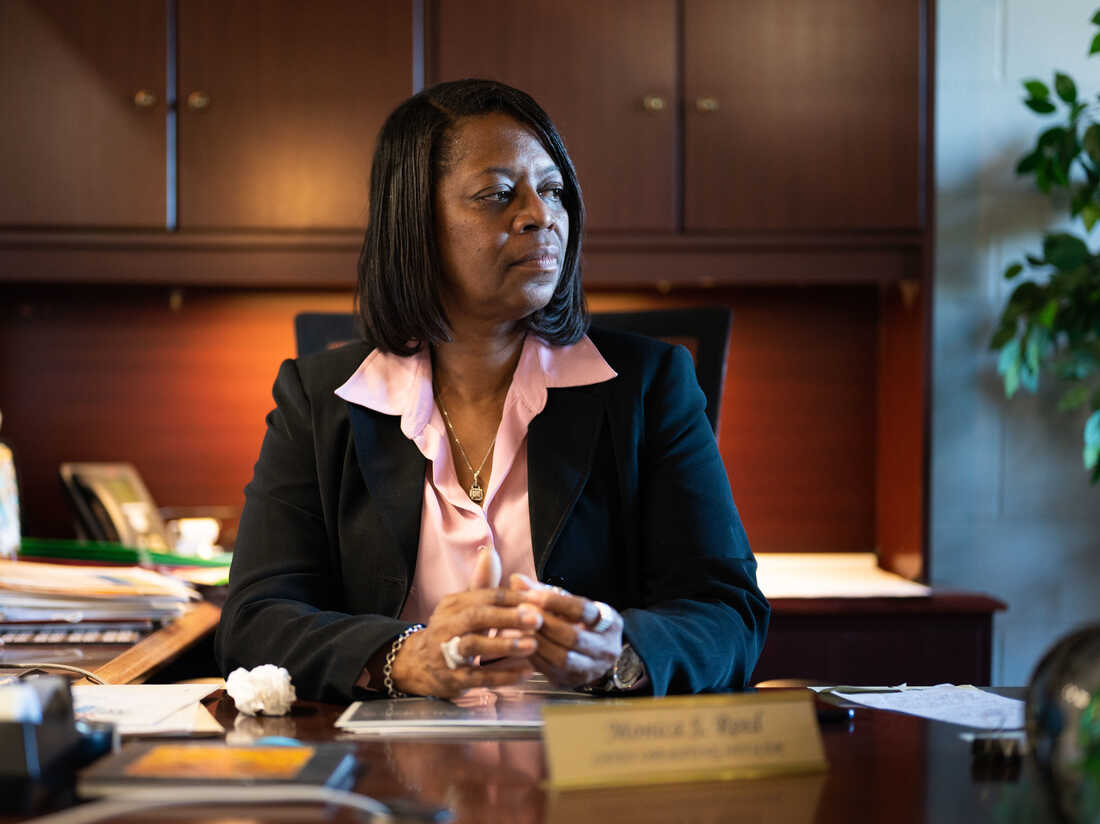
Diagnosed with cancer five years ago, Monica Reed of Knoxville, Tennessee, was left with nearly $10,000 in medical bills she couldn’t pay. Medical debt is more prevalent among the Black community in Knoxville, than among whites.
Jamar Coach for KHN and NPR


hide caption
toggle caption
Jamar Coach for KHN and NPR

Diagnosed with cancer five years ago, Monica Reed of Knoxville, Tennessee, was left with nearly $10,000 in medical bills she couldn’t pay. Medical debt is more prevalent among the Black community in Knoxville, than among whites.
Jamar Coach for KHN and NPR
When Dr. H.M. Green opened his new medical office building on East Vine Avenue in 1922, Black Knoxville residents could be seen only in the basement of Knoxville General Hospital. They were barred from the city’s other three medical centers.
Green, one of America’s leading Black physicians, spent his life working to end health inequities like this. He installed an X-ray machine, an operating room, and a private infirmary in his building to serve Black patients. On the first floor was a pharmacy.
Today the Green Medical Arts Building has been replaced by a tangle of freeways that were built after the city’s Black business district was bulldozed in a midcentury urban renewal project.
But the health gaps Green labored to narrow still divide this community. And if segregation is less apparent in medical offices today, its legacy lives on in crushing medical debt that disproportionately burdens this city’s Black community.
In and around Knoxville, residents of predominantly Black neighborhoods are more than twice as likely as those in largely white neighborhoods to owe money for medical bills, Urban Institute credit bureau data shows — it’s one of the widest racial disparities in the country.
That tracks with a disturbing national trend. Health care debt in the U.S. now affects more than 100 million people, a KHN-NPR investigation found. But the toll has been especially high on Black communities: 56% of Black adults owe money for a medical or dental bill, compared with 37% of white adults, according to a nationwide KFF poll conducted for this project.
The explanation for that startling disparity is deeply rooted. Decades of discrimination in housing, employment, and health care blocked generations of Black families from building wealth — savings and assets that are increasingly critical to accessing America’s high-priced medical system.
Against that backdrop, patients suffer. People with debt avoid seeking care and become sicker with treatable chronic conditions like diabetes or multiple sclerosis. Worse still, hospitals and doctors sometimes won’t see patients with medical debt — even those in the middle of treatment.
“African Americans don’t seek health care until we are really, really sick, and then it costs more,” said Tabace Burns, a former emergency room nurse in Knoxville. Burns, who is also a leader in her church, said she routinely helps members of her congregation find medical care they should have sought earlier.
Nationwide, Black adults who have had health care debt are twice as likely as white adults with such debt to say they’ve been denied care because they owe money, the KFF poll found. Many Black Americans also ration their care out of fear of cost.

Dr. H.M. Green was a leading Black physician in the early 20th century who fought discrimination in health care. His clinic was torn down when Knoxville, Tennessee, bulldozed Black neighborhoods during a midcentury urban renewal project.
Beck Cultural Exchange Center in Knoxville, Tenn.
hide caption
toggle caption
Beck Cultural Exchange Center in Knoxville, Tenn.

Dr. H.M. Green was a leading Black physician in the early 20th century who fought discrimination in health care. His clinic was torn down when Knoxville, Tennessee, bulldozed Black neighborhoods during a midcentury urban renewal project.
Beck Cultural Exchange Center in Knoxville, Tenn.
Burns recalled a friend who came to see her about an oozing growth on her breast. “She didn’t have any insurance, so she just thought it would get better,” Burns said.
Burns helped the woman find an oncologist to treat what turned out to be cancer. There was a cost to waiting so long, though. Because the cancer was so advanced, the friend had to undergo chemotherapy and have both breasts removed.
It could have been worse. “What if she didn’t know me? What if she just continued to let her breast leak and it was necrotic?” Burns said. But, she added, if her friend hadn’t been so worried about going into debt, she would have gone to the doctor sooner.
It’s a terrible cycle, said Berneta Haynes, a staff attorney at the National Consumer Law Center. “This legacy of segregation and structural racism underlies the racial health gap,” she said. “It impacts health outcomes and access. And it impacts the level of medical debt.”
In ‘The Bottom’
The story of how Knoxville’s Black residents came to be its primary victims of medical debt is written in the city’s changing landscape.
Just outside downtown, below refurbished office buildings and former warehouses, is an area once called The Bottom, long the heart of the Black community.
This area persevered through decades of Jim Crow segregation and violence. In one of the worst episodes, mobs of white rioters in 1919 vandalized Black-owned stores and shot residents after a young Black man was accused of killing a white woman.

Left: Central Street and Vine Avenue, pictured in 1949, was the heart of the Black business district in Knoxville, Tenn., with grocers, pool halls, a YMCA, and the Gem Theatre, where Billie Holiday played. Right: Today a tangle of freeways stands where Knoxville’s Black business district once thrived.
Beck Cultural Exchange Center in Knoxville, Tenn. and Jamar Coach for KHN and NPR
hide caption
toggle caption
Beck Cultural Exchange Center in Knoxville, Tenn. and Jamar Coach for KHN and NPR
It was here that Black physicians like Green opened medical offices alongside grocers, pool halls, and funeral homes. Knoxville’s first Black millionaire, a former enslaved man who’d made a fortune in horse racing and saloons, built a YMCA. Billie Holiday and Cab Calloway performed at the Gem Theatre.
Beginning in the late 1950s, the city systematically wiped out The Bottom and surrounding neighborhoods in an urban renewal and highway-building campaign. Officials razed more than 500 homes, 15 churches, and more than 100 Black-owned businesses, including Green’s medical building.
More than 2,500 families were displaced. Many ended up in public housing projects. Others left Knoxville. Businesses never reopened. “It changed the whole landscape,” said the Rev. Reneé Kesler, director of the Beck Cultural Exchange Center, a nonprofit that preserves Knoxville’s Black history. “You’ll have generations that won’t recover from that.”
What urban renewal left behind in East Knoxville was a neighborhood that’s the poorest in the city — and has the largest share of Black residents.
A tiny fraction of residents are homeowners. Blocks are blighted by boarded-up buildings and overgrown lots. Down the street from Knoxville’s oldest Black cemetery, a Dollar General recently closed — one of the few stores around that sold groceries.
The neighborhood’s residents are sicker than those elsewhere in Knoxville, with higher levels of diabetes and other chronic illnesses. They are less likely to have health insurance.
They also have much more medical debt.
More than 30% of the people have a medical bill on their credit record, according to credit bureau data collected by the nonprofit Urban Institute. A few miles west in Knoxville’s overwhelmingly white suburbs, fewer than 10% carry such debt.

Midcentury urban renewal and highway-building in Knoxville, Tennessee, wiped out the Black business district and neighborhoods like The Bottom. “We concentrated Black poverty,” says city council member Gwen McKenzie.
Jamar Coach for KHN
hide caption
toggle caption
Jamar Coach for KHN

Midcentury urban renewal and highway-building in Knoxville, Tennessee, wiped out the Black business district and neighborhoods like The Bottom. “We concentrated Black poverty,” says city council member Gwen McKenzie.
Jamar Coach for KHN
It’s not difficult to understand the difference, said Eboni Winford, a clinical psychologist at Cherokee Health Systems, a network of clinics that serve low-income patients. “Black people are less likely to have generational wealth to pass on, which means we don’t have the pockets of money that we can just use if medical bills arise.”
Nationally, the median white family now has about $184,000 in assets such as homes, savings, and retirement accounts, according to an analysis by the Federal Reserve Bank of St. Louis. The assets of the median Black family total just $23,000.
“What happened is we concentrated Black poverty,” said Gwen McKenzie, a Knoxville City Council member who grew up not far from The Bottom. “From there, that’s where it became generational.”
‘Always a sacrifice’
Monica Reed lives just up the hill from where The Bottom once was.
She considers herself luckier than most. Born in Knoxville and raised by a single mother, Reed became the first in her family to own a home, a small house built after the city demolished The Bottom. For the past 15 years, she’s worked for a faith-based nonprofit that assists low-income residents of Knoxville.
“It hasn’t always been easy,” said Reed, who just turned 60. She raised her son by herself. And though she’s always worked, her modest salary made saving difficult. “I just tried to live a frugal kind of life,” she said. “And by the grace of God, I didn’t become homeless.”
She couldn’t escape medical debt, though. Diagnosed with cancer five years ago, Reed underwent surgery and chemotherapy. Although she had health insurance through work, she was left with close to $10,000 in medical bills she couldn’t pay.
She’s been pursued by debt collectors and even taken to court. That’s forced Reed to make difficult choices. “There’s always a sacrifice,” she said. “You just do without some things to pay other things.”
Reed said she cut back on trips to the grocery store: “I don’t buy a lot of food. Just plain and simple.”
She has adjusted, she said. “You just do what you have to do.” What angers Reed, though, is how she’s been treated by the cancer center where she goes for periodic checkups to make sure the cancer remains in remission. When she recently tried to make an appointment, a financial counselor told her she couldn’t schedule it until she made a plan to pay her bills.
“I was so upset, I didn’t even find out how much I owed,” Reed said. “I mean, I wasn’t calling about a little toothache. This is something that affects someone’s life.”
Locking in disparities
Health insurance gains made possible by the Affordable Care Act have narrowed some racial health disparities, studies show.
The expansion of Medicaid, in particular, has brought new financial security to millions of low-income Americans. In a recent analysis of credit bureau and census data, researchers estimated that Medicaid expansion helped enrollees avoid more than $1,200 in medical debt.
But many of those gains have remained out of reach in Knoxville. Tennessee is among 12 states that have rejected federal funding to expand the Medicaid safety net through the 2010 health care law.
Eight of the 12 are Southern states with large Black populations. The decision not to expand has disproportionately affected communities like East Knoxville that are already contending with deep racial disparities in health and wealth.
Of the roughly 2.2 million people locked out of health coverage because these states rejected Medicaid expansion, nearly 60% are people of color, according to a KFF analysis. About a quarter are Black.
Locked out of health insurance, many just try to hang on until they become eligible for Medicare, said Cynthia Finch, an advocate in Knoxville who has worked to improve health in the city’s Black community. “People pray they don’t get sick before they are 65,” she said.
If Black patients go into debt, they face yet another challenge: a medical debt collections industry that targets Black debtors more aggressively than their white counterparts, particularly for smaller debts.
About 6 in 10 Black adults with medical debts under $2,500 say they or someone in their household has been contacted by a collection agency in the past five years, the KFF poll found. By contrast, only about 4 in 10 white adults with similar debt said the same.
At the courthouse in downtown Knoxville, the dockets are filled with debt collection lawsuits filed by some of the region’s largest hospitals: Fort Sanders Regional Medical Center, East Tennessee Children’s Hospital, and Parkwest Medical Center.
That discourages many Black patients from seeking care even if they need it, said Cherokee Health’s Derrick Folsom, who helps patients enroll in health insurance. “Somebody knows somebody who’s getting sued for medical bills,” Folsom said. “So they stay away from medical centers.”
Reflecting on her experience with medical debt, Reed said she tries to stay upbeat. “I don’t sweat the small stuff,” she said. “What am I going to do against this hospital?”
But, she said, she has realized one thing about the nation’s health care system: “It’s not designed for poor people.”
Source by www.npr.org
